Defend Against Real Threats
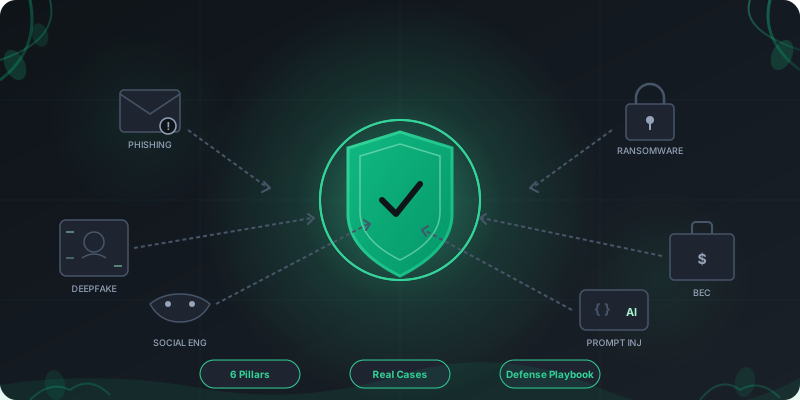
Each guide covers how attackers run the threat in 2026, the defensive layers that work, and the training scenarios that build the human reflex.
Phishing
The fraudulent message attack that drives most enterprise breaches across email, SMS, voice, QR, and chat.
Read the guideRansomware
Encryption-and-extortion malware that costs enterprises an average of $5.13M per incident, per IBM 2024.
Read the guideDeepfake
AI-cloned voice and video that impersonates executives to authorize wires, leak data, and bypass verification.
Read the guideSocial Engineering
The human-layer attack that manipulates targets into bypassing their own controls across email, voice, SMS, in-person, and live video.
Read the guideBusiness Email Compromise
The targeted email fraud that drove $2.9 billion in 2023 FBI IC3 reported losses by impersonating executives, vendors, and trusted partners.
Read the guideAI Prompt Injection
Adversarial instructions hidden in content that hijack enterprise LLMs and AI agents into leaking data or taking unauthorized actions.
Read the guideSmishing
SMS phishing that lands in the one inbox with no security gateway in front of it, read within minutes and tapped on a small screen.
Read the guideVishing
Voice phishing that uses a live call, a spoofed number, and now a cloned voice to talk targets past the controls that protect email.
Read the guideHow we sequence threat coverage
The threat library is sequenced by the empirical breach record, not by what a vendor wants to sell. Phishing leads because it remains the dominant initial-access vector in the Verizon DBIR series. Ransomware follows because it carries the highest single-incident cost and has shifted from opportunistic to vendor-impersonation since 2023. Business email compromise sits beside ransomware in dollar exposure and is still the top FBI IC3 loss category. Social engineering is the parent abstraction; the named groups (Scattered Spider, 0ktapus, FIN7, TA453) all live inside it.
Deepfake and AI prompt injection are newer, but the public-disclosure curve is steep. The 2024 Arup $25 million case redefined the threat for finance and treasury teams. Microsoft 365 Copilot, Slack AI, and Bing Chat have all shipped post-disclosure mitigations for prompt-injection chains that exfiltrated data without a click. We surface both pillars because the defensive controls (verification reflex, agent permission scoping, retrieval allowlisting) are still maturing in most enterprises and need explicit training programs rather than ad-hoc memos.
Each pillar follows the same structure: definition, attacker workflow, real cases with named victims, the defense framework, and the exact training scenarios from the 200+ exercise catalogue that drill the human side. Sources are listed at the end of every pillar so security leaders can cite the same primary research the page does: CISA advisories, FBI joint cybersecurity advisories, NIST publications, IBM and Sophos threat reports, OWASP LLM Top 10, and the Verizon DBIR.
Frequently asked questions
What security leaders ask about threat training.
Which threats should a new security awareness program cover first?
How often should each threat be re-trained?
How do these threat pillars relate to the exercise catalogue?
Are these guides specific to the United States, or international?
See RansomLeak in Action
Try the free exercises or book a demo to see analytics, SCORM export, SSO, and custom content in your environment.