Compliance Mapping Guide
See exactly which RansomLeak exercises satisfy requirements for SOC 2, ISO 27001, ISO 27701, NIST CSF 2.0, GDPR, EU AI Act, CCPA / CPRA, HIPAA, HITRUST, PCI DSS, NIS2, DORA, and CMMC. Map your training program to compliance controls.
Each table below links specific framework requirements to the courses and exercises that address them, so you can build a training plan that satisfies your auditors. Coverage by OWASP, CWE, MITRE ATT&CK and CIS identifier follows the framework tables.
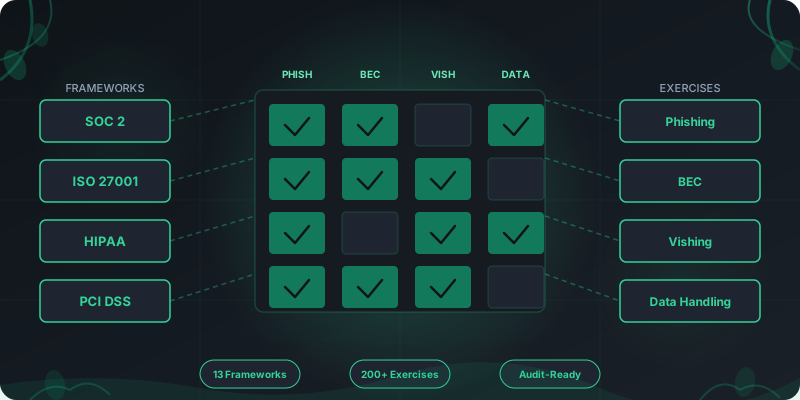
How Does RansomLeak Map to SOC 2 Requirements?
SOC 2 Trust Services Criteria require organizations to demonstrate security awareness across their workforce. RansomLeak exercises map directly to Common Criteria controls, giving auditors the evidence they need.
How Does RansomLeak Map to ISO 27001 Requirements?
ISO 27001 Annex A controls require documented security awareness programs. RansomLeak provides structured training content and completion tracking that satisfies these controls during certification audits.
How Does RansomLeak Map to ISO 27701 Requirements?
ISO 27701 extends ISO 27001 with privacy information management controls aligned to GDPR. Annex B covers PII controllers (purpose, lawful basis, consent, data subject rights, transfers) and Annex C covers PII processors (processing under instructions, sub-processors, return and disposal of PII).
How Does RansomLeak Map to NIST CSF 2.0?
NIST Cybersecurity Framework 2.0 organizes security around six functions: Govern, Identify, Protect, Detect, Respond, and Recover. The Protect function explicitly mandates a workforce awareness program (PR.AT-1), with adjacent functions requiring competency in detection, response, and recovery.
How Does RansomLeak Map to GDPR Requirements?
GDPR Articles 39 and 47 require data protection training for employees who process personal data. RansomLeak offers a dedicated GDPR Compliance course with exercises that cover breach response, data subject rights, and privacy by design.
How Does RansomLeak Map to EU AI Act Requirements?
The EU AI Act establishes legally binding obligations for organizations that develop, deploy, or use AI systems in the European Union. Articles 4, 14, 26, 27, 50, and 62 explicitly mandate workforce training, AI literacy, and competency in human oversight. RansomLeak ships a dedicated EU AI Act Compliance course with 16 interactive exercises that map article-by-article to the regulation.
How Does RansomLeak Map to CCPA / CPRA Requirements?
The California Consumer Privacy Act and its successor the California Privacy Rights Act grant California residents specific rights over their personal information. Businesses must train staff on identifying valid requests, opt-out workflows, sensitive PI handling, and breach response under §1798.150.
How Does RansomLeak Map to HIPAA Requirements?
HIPAA Security and Privacy Rules mandate workforce training on safeguarding protected health information. RansomLeak exercises address the specific administrative, physical, and technical safeguards outlined in 45 CFR Part 164.
How Does RansomLeak Map to HITRUST CSF Requirements?
HITRUST CSF is the dominant framework for healthcare and high-trust environments, harmonizing HIPAA, NIST, ISO 27001, and PCI DSS into a single certifiable control set. Workforce awareness and training requirements appear across multiple control categories from Information Security Management to Privacy Practices.
How Does RansomLeak Map to NIS2 Requirements?
The NIS2 Directive requires essential and important entities across the EU to implement cybersecurity training and hygiene practices. Article 21 specifically mandates human resources security and awareness programs.
How Does RansomLeak Map to PCI DSS Requirements?
PCI DSS v4.0 Requirement 12.6 mandates a formal security awareness program for all personnel. RansomLeak training satisfies this requirement with documented completion records and threat-specific content updates.
How Does RansomLeak Map to DORA Requirements?
The Digital Operational Resilience Act (DORA) requires financial entities to implement ICT security awareness programs and test their operational resilience. RansomLeak delivers training that addresses Articles 13, 17, 25, and 28.
How Does RansomLeak Map to CMMC Level 1 Requirements?
CMMC Level 1 (Foundational) implements the 17 basic safeguarding requirements of FAR 52.204-21 for U.S. defense contractors handling Federal Contract Information. While many requirements are technical, several mandate workforce awareness around access control, identification, media handling, physical security, and malicious-code protection.
Coverage by Security Taxonomy
The tables above answer an auditor asking which control a course satisfies. The tables below answer a security team asking which specific risk an exercise teaches. Every identifier is read from the catalogue itself, so a content release keeps them current instead of leaving them stale.
Which OWASP Top 10 Web Risks Does RansomLeak Cover?
The Application Security course drills each web risk as an exploitable scenario rather than a definition. Both the 2021 and 2025 lists appear, because most audit programmes still reference 2021 while newer work cites 2025.
Which OWASP API Security Top 10 Risks Does RansomLeak Cover?
API failures are usually authorization logic rather than input handling, so these exercises put the learner on the endpoint that trusts its client. Coverage spans the 2019 and 2023 editions.
| Identifier | What it covers | Exercises |
|---|---|---|
| OWASP API API1:2023 | Broken Object Level Authorization | Broken Object Level Authorization |
| OWASP API API2:2023 | Broken Authentication | Broken User Authentication |
| OWASP API API3:2019 | Excessive Data Exposure | Excessive Data Exposure |
| OWASP API API4:2023 | Unrestricted Resource Consumption | Unrestricted Resource Consumption |
| OWASP API API5:2023 | Broken Function Level Authorization | Broken Function Level Authorization |
| OWASP API API6:2019 | Mass Assignment | Mass Assignment |
| OWASP API API8:2019 | Injection | Injection |
| OWASP API API8:2023 | Security Misconfiguration | Security Misconfiguration |
| OWASP API API9:2023 | Improper Inventory Management | Improper Inventory Management |
| OWASP API API10:2019 | Insufficient Logging & Monitoring | Insufficient Logging & Monitoring |
Which OWASP Top 10 LLM Risks Does RansomLeak Cover?
Prompt injection, sensitive data exposure and supply chain risk in language model applications. The 2025 and 2026 lists are both mapped, since procurement questionnaires still cite either one.
Which OWASP Agentic Top 10 Risks Does RansomLeak Cover?
Agentic risks are behavioural rather than syntactic: an agent holding the right permissions does the wrong thing. Each exercise puts the learner inside the loop where that decision gets made.
| Identifier | What it covers | Exercises |
|---|---|---|
| OWASP ASI01:2026 | Agent Goal Hijack | AI Agent Goal Hijacking |
| OWASP ASI02:2026 | Tool Misuse & Exploitation | AI Agent Tool Exploitation |
| OWASP ASI03:2026 | Identity & Privilege Abuse | Agent Identity and Privilege Abuse |
| OWASP ASI04:2026 | Agentic Supply Chain Vulnerabilities | Agentic AI Supply Chain Attack |
| OWASP ASI05:2026 | Unexpected Code Execution (RCE) | AI Agent Code Injection |
| OWASP ASI06:2026 | Memory & Context Poisoning | AI Agent Memory Poisoning |
| OWASP ASI07:2026 | Insecure Inter-Agent Communication | Agent-to-Agent Communication Spoofing |
| OWASP ASI08:2026 | Cascading Failures | Multi-Agent Cascading Failure |
| OWASP ASI09:2026 | Human-Agent Trust Exploitation | Over-Trusting AI Agent Recommendations |
| OWASP ASI10:2026 | Rogue Agents | Rogue AI Agents |
Which OWASP MCP Top 10 Risks Does RansomLeak Cover?
The Model Context Protocol course covers tool poisoning, token exposure and scope creep across a full agent toolchain. It is the newest list in the catalogue and maps one exercise to each risk.
| Identifier | What it covers | Exercises |
|---|---|---|
| OWASP MCP MCP01:2025 | Token Mismanagement & Secret Exposure | Leaked MCP Tokens |
| OWASP MCP MCP02:2025 | Privilege Escalation via Scope Creep | Agent Scope Creep |
| OWASP MCP MCP03:2025 | Tool Poisoning | Poisoned Tool Descriptions |
| OWASP MCP MCP04:2025 | Supply Chain & Dependency Tampering | Typosquatted MCP Package |
| OWASP MCP MCP05:2025 | Command Injection & Execution | MCP Command Injection |
| OWASP MCP MCP06:2025 | Intent Flow Subversion | Hijacked Agent Intent |
| OWASP MCP MCP07:2025 | Insufficient AuthN/AuthZ | Unauthenticated MCP Server |
| OWASP MCP MCP08:2025 | Lack of Audit & Telemetry | Missing MCP Audit Trail |
| OWASP MCP MCP09:2025 | Shadow MCP Servers | Shadow MCP Servers |
| OWASP MCP MCP10:2025 | Context Injection & Over-Sharing | Cross-Tenant Context Leak |
Which MITRE CWE Weaknesses Does RansomLeak Cover?
A CWE identifier pins an exercise to the exact weakness it teaches, which is what a secure development policy or a customer security questionnaire usually asks for. Coverage spans the application, API, cloud and repository tracks.
Which MITRE ATT&CK Techniques Does RansomLeak Cover?
ATT&CK maps training to attacker behaviour rather than to code defects, so a detection team can line up awareness coverage against the techniques it already tracks. Sub-techniques are listed separately where the catalogue teaches them separately.
How Does RansomLeak Map to CIS Critical Security Controls?
Control 14 is the security awareness safeguard, but the catalogue supports many of the others too. Broad controls list the ten most on-point exercises here, and the identifier links through to the full set in the library.
Frequently asked questions
Which compliance frameworks does RansomLeak training cover?
RansomLeak training maps to thirteen major frameworks: SOC 2, ISO 27001, ISO 27701, NIST CSF 2.0, GDPR, the EU AI Act, CCPA / CPRA, HIPAA, HITRUST CSF, PCI DSS, NIS2, DORA, and CMMC Level 1. Each framework has specific requirement areas linked to relevant courses and exercises.
Eight security taxonomies sit alongside them: the OWASP Top 10 lists for web, API, LLM, agentic and MCP applications, plus MITRE CWE, MITRE ATT&CK and the CIS Critical Security Controls.
This page is the cross-reference matrix for scope comparison. For framework deep dives (audit failure modes, named enforcement actions, control-by-control coverage), see the compliance framework guides.
Does RansomLeak map exercises to OWASP, CWE, and MITRE ATT&CK?
Yes. Every exercise carries the OWASP, CWE, MITRE ATT&CK, CIS, NIST CSF, GDPR and EU AI Act identifiers it maps to. Those identifiers show on the exercise card in the catalogue as well as in the coverage tables on this page.
The tables are generated from the same data the catalogue uses, so they track content releases instead of being maintained by hand. You can also filter the library by identifier, for example CWE-89 or T1566.
Can RansomLeak generate audit-ready compliance reports?
Yes. The platform exports compliance reports in PDF, CSV, and Excel formats that document training completion by employee, department, and framework requirement. Reports include timestamps, scores, and evidence of participation.
Auditors can verify that specific controls have been addressed through structured training records without manual data collection.
How often should compliance training be refreshed?
Most frameworks require at least annual training, but best practice is quarterly or monthly updates. SOC 2 and ISO 27001 auditors expect to see ongoing awareness activities, not just a single annual session.
RansomLeak ships new content monthly, so you can assign fresh exercises on a regular cadence without repeating the same material.
Does RansomLeak support SCORM for compliance LMS tracking?
Yes. Every exercise exports as a SCORM 1.2 or SCORM 2004 package that runs inside your existing LMS. Completion data, scores, and time spent flow directly into your LMS reporting system.
Visit our SCORM integration page for details on supported platforms and deployment steps.
Can training be customized for specific compliance requirements?
Yes. Our content team builds custom exercises tailored to your regulatory environment. Healthcare organizations can get HIPAA-specific scenarios. Financial institutions can focus on PCI DSS and DORA requirements.
Custom content follows the same interactive 3D format and integrates with the standard compliance reporting tools.
What evidence does RansomLeak provide for auditors?
RansomLeak generates detailed training records that include employee name, department, exercise completed, date, time spent, score, and the specific compliance control addressed. These records are exportable and retention policies keep historical data available for multi-year audits.
For organizations using SCORM, the LMS maintains its own independent audit trail alongside RansomLeak records.
Map Your Training to Compliance
Talk to our team about building a compliance-aligned training program. Read the CISO buyer's guide for evaluation criteria, or explore the full exercise catalogue.