Security Awareness Training Platform Comparison
15 Human Risk Management and security awareness training vendors scored in one matrix across training method, phishing simulation, AI coverage, SCORM and LTI portability, compliance, data residency, and pricing. Head-to-head matchups and multi-vendor roundups below.
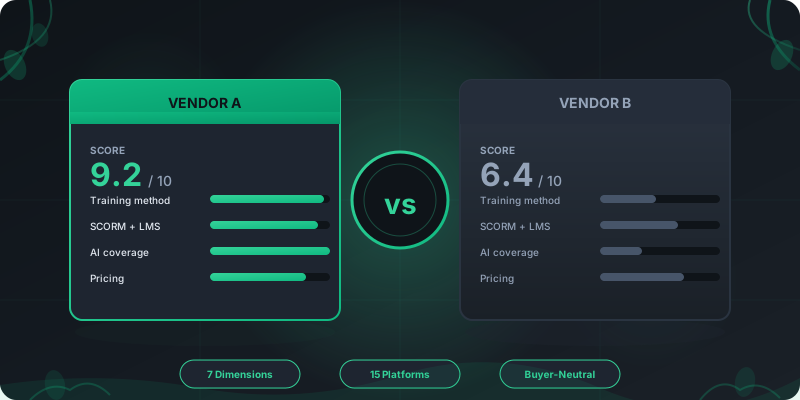
How to Compare Security Awareness Training Vendors
The security awareness training market has fragmented into three distinct categories since 2024. Legacy SAT platforms like KnowBe4 and Proofpoint lead with video libraries and phishing simulation. New-wave Human Risk Management vendors like Hoxhunt, SoSafe, and CybSafe lead with adaptive personalization and behavior analytics. Specialist interactive-simulation vendors like RansomLeak lead with scenario-based practice and SCORM portability for existing LMS stacks.
Seven Dimensions to Evaluate
The same framework we use in every vendor comparison post below.
Training method
Video-based passive content, interactive simulation, adaptive personalization, or micro-learning clips. Active practice retention exceeds passive video by roughly 75% vs 5% per the National Training Laboratories Learning Pyramid, so training method is a first-order filter.
Phishing simulation
Inbox-level automated simulation at enterprise scale. Hoxhunt, KnowBe4 PhishER, and Cofense PhishMe lead on campaign tooling depth. RansomLeak delivers email campaigns through Microsoft 365 and Google Workspace plus SMS campaigns for smishing, then assigns the exercise matching whatever an employee missed. The question to ask a vendor is whether it sends real campaigns or only teaches phishing inside a module.
Topic breadth and AI coverage
Core phishing, BEC, and ransomware versus expanded topics like AI threats, deepfakes, shadow AI, prompt injection, quishing, and callback phishing. Most legacy vendors update core topics quarterly and add AI topics reactively. Track which vendors ship OWASP LLM Top 10 and Agentic AI content.
SCORM and LTI portability
Full SCORM 1.2 and 2004 export, plus an LTI 1.3 launch with automatic grade passback, for Moodle, Canvas, Cornerstone, Workday, Docebo, SAP SuccessFactors, and the rest. Organizations with an LMS-of-record need this portability. Most legacy SAT and HRM vendors export SCORM but do not document an LTI 1.3 launch. Vendors like Hoxhunt and SoSafe that require their own hosted platform force teams to maintain two LMSes.
Compliance framework coverage
Control mapping for SOC 2, ISO 27001, HIPAA, PCI DSS, GDPR, NIS2, DORA, and FTC Safeguards. Audit-ready evidence packages, retention timelines, and signed completion records matter more than mapping claims alone.
Data residency and regulatory fit
EU data residency, UK hosting, US FedRAMP, or configurable region. NIS2 essential entities and DORA-covered financial firms often require EU-only processing. US healthcare and financial institutions navigate HIPAA and GLBA Safeguards. Residency architecture is hard to change post-purchase.
Pricing model and total cost
Per-user per-year flat rate, tiered by employee count, freemium with paid add-ons, or custom enterprise quote. Published G2 pricing ranges are $1.50 to $3.25 per user per month for KnowBe4, higher tiers for Hoxhunt and SoSafe. Factor phishing-simulation add-ons, content updates, and SCORM-export fees separately.
The Fifteen-Platform Matrix
Every vendor below is scored against the same seven dimensions. Capability columns read full, partial, or absent; method, residency, and pricing carry the value itself.
Scroll the table sideways to see every dimension.
| Platform | Training method | Phishing simulation | AI threat coverage | SCORM and LTI | Compliance coverage | Data residency | Pricing model |
|---|---|---|---|---|---|---|---|
| RansomLeak | Interactive 3D scenarios | Email and SMS campaigns | OWASP LLM Top 10, prompt injection, deepfake | SCORM 1.2, SCORM 2004, LTI 1.3 | SOC 2, ISO 27001, HIPAA, PCI DSS, GDPR, NIS2 | US or EU region, private cloud, on-prem | Custom, free for individuals |
| KnowBe4 | Video library and games | PhishER, Smart Delivery | AI Defense Agents, select modules | SCORM export, no documented LTI | Broad framework mapping | US-based, EU processing addendum | About $1.50 to $3.25 per user per month |
| Hoxhunt | Adaptive micro-training | Adaptive, per-employee difficulty | AI-generated phishing only | No SCORM export | Phishing-centric reporting | EU (Finland) and US | Custom, premium tier |
| SoSafe | Behavioral microlearning | Template-driven engine | Some AI phishing content | SCORM export, platform-first | NIS2, DORA, ISO 27001, TISAX | EU-hosted (Germany) | Custom enterprise |
| Proofpoint | Video modules and assessments | Campaigns driven by TAP data | Phishing and compliance focus | Limited SCORM, platform-first | Broad enterprise frameworks | US, EU processing options | Custom, often suite-bundled |
| NINJIO | Animated episodes, 3 to 4 minutes | Simulation campaigns | Select AI episodes | SCORM supported | Lighter compliance reporting | US | Per-user annual contract |
| CybSafe | Behavioral science, SebDB-backed | Integrated simulation | Lighter AI content | SCORM available | Behavior analytics, UK and EU frameworks | UK and EU | Custom, premium tier |
| Living Security | HRM analytics with training | Often through partners | Moderate coverage | SCORM available | GRC integration, board reporting | US | Custom enterprise |
| MetaCompliance | Awareness plus policy attestation | Integrated simulation | Limited AI coverage | SCORM export | GDPR, ISO 27001, policy attestation | UK and EU | Custom enterprise |
| Phished | AI-generated micro-learning | Fully automated campaigns | AI generates simulations | No SCORM export | GDPR-focused | EU (Belgium) | Custom enterprise |
| Cofense | Phishing defense and reporting | PhishMe, reporting-led | Limited beyond phishing | SCORM available | Phishing-centric | US, EU option | From about $10 per seat per year |
| usecure | Video modules and assessments | Automated, risk-based | Limited AI coverage | No SCORM export | SMB and MSP baseline | UK and EU | Per-seat, MSP channel |
| Huntress (Curricula) | Story-driven episodes | Simulations included | Limited AI coverage | SCORM 1.2 on the CIP track | SMB and NERC CIP tracks | US | Quote-based, MSP channel |
| Wizer | Short-form video microlearning | Paid tiers only | Limited AI coverage | SCORM on paid tiers | Basic reporting | US and Israel | Free tier, paid under $2 per user per month |
| CanIPhish | Phishing-first, light awareness | Core product, free tier | Limited AI coverage | SCORM available | Thin compliance coverage | Configurable regions | Pay as you go, free tier |
Values are drawn from vendor documentation, public G2 and Gartner Peer Insights disclosures, and our own head-to-head reviews linked from each platform name. Quote-only vendors are marked as such rather than estimated. Where a vendor publishes no figure, we do not invent one.
Multi-Vendor Roundups
Comparing three or more vendors in a single post.
Best Security Awareness Training Platforms 2026
Eight vendors scored across training method, AI coverage, SCORM support, compliance fit, and pricing band. Procurement-ready evaluation matrix with ideal buyer per vendor.
Read the 2026 buyer guideKnowBe4 Alternatives Compared
Seven direct KnowBe4 alternatives with feature tables, pricing ranges, and migration considerations. Covers teams leaving KnowBe4 for engagement, AI coverage, or cost reasons.
See KnowBe4 alternativesHoxhunt Alternatives: 7 Platforms Compared
Hoxhunt and six direct alternatives on phishing simulation scope, training depth, pricing, and ideal buyer. Useful for teams that want broader training than Hoxhunt ships by default.
See Hoxhunt alternativesHead-to-Head Comparisons
Detailed one-on-one matchups with feature tables and buyer guidance.
RansomLeak vs KnowBe4
Interactive 3D simulations vs video-based content library. Eight-dimension comparison table, pricing discussion, and guardrails on where KnowBe4 still wins (inbox-level phishing at enterprise scale).
RansomLeak vs Hoxhunt
Full-spectrum interactive training vs AI-adaptive phishing-only focus. Covers when to pair them versus when one replaces the other.
RansomLeak vs SoSafe
EU-focused HRM suite vs interactive simulations. Deep on regulatory fit (NIS2, DORA, TISAX), data residency, AI coverage, and buyer profile.
RansomLeak vs Proofpoint
Standalone interactive training vs email-security-suite integration. Vendor lock-in analysis and deployment flexibility for teams already on Proofpoint email gateway.
RansomLeak vs Ninjio
Interactive practice vs Hollywood-style micro-learning videos. When cinematic storytelling beats hands-on scenarios and the reverse.
RansomLeak vs Phished
Hands-on 3D simulations vs AI-automated phishing campaigns. GDPR compliance, training depth, and automation tradeoffs.
RansomLeak vs Usecure
Enterprise interactive simulations vs MSP-focused automated training. Multi-tenant management, feature scope, and pricing for partner-led deployments.
Matchups That Do Not Involve Us
The two comparisons buyers ask for most often, written without a thumb on the scale.
KnowBe4 vs Proofpoint
The decision usually turns on whether Proofpoint already runs your email security, because that is what unlocks threat-intelligence-driven simulations. Covers library depth, SCORM limits on both sides, and the lock-in arithmetic.
Hoxhunt vs KnowBe4
An adaptive phishing engine with training attached, against a broad awareness platform with a phishing engine attached. Covers engagement design, compliance evidence, the SCORM gap, and why the cheaper per-seat rate is often the higher total.
Frequently asked questions
What is the difference between security awareness training and Human Risk Management?
Is KnowBe4 still the market leader in 2026?
Do I need a separate phishing simulation tool?
Which vendor is best for EU NIS2 compliance?
Can I run multiple security awareness training vendors in parallel?
How do I decide between an HRM platform and a standalone training library?
See RansomLeak in Action
Try the free exercises or book a demo to see analytics, SCORM export, SSO, and custom content in your environment.