Open-Source Security Awareness Training
Download 200+ interactive security awareness modules as SCORM packages, free and open under Creative Commons. Import phishing, ransomware, GDPR, and AI-threat courses straight into your own LMS. Free for non-commercial use under CC BY-NC, no signup required.
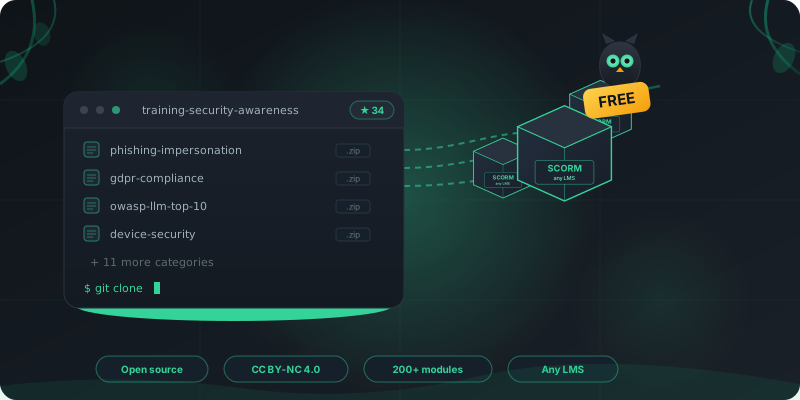
What's inside the open-source library
Every module is a hands-on, first-person scenario set in an interactive 3D office, not a video or a quiz deck. Take a full course package, or pull individual exercises to build your own curriculum.
Phishing & Impersonation
Phishing, spear phishing, whaling, business email compromise, smishing, QR-code scams, and tech-support fraud.
Device Security
Ransomware, USB attacks, backups, encryption, patching, Bluetooth, and risky file extensions.
Passwords & Account Security
Password managers, multi-factor authentication, credential stuffing, privileged access, and account recovery.
Web & Browser Safety
HTTPS, safe downloads, typosquatting, autofill risks, browser extensions, and push notifications.
Safe Communication & Sharing
Social media, cloud sharing, OAuth permissions, and secure messaging habits.
Protecting Sensitive Information
Data leakage, classification, identity theft, and sharing records safely.
Workplace Security
Insider threats, shadow IT, and everyday collaboration hygiene.
Remote & Home Office Security
VPN usage and securing the home router your team works behind.
Security Policies & Your Role
Audit mindset, individual responsibilities, and reading the policy that applies to you.
Incident Reporting
How and when to report, and how to build a culture where people speak up.
GDPR Compliance
Consent, breach response, processor vetting, data protection impact assessments, and data subject access requests.
EU AI Act Compliance
AI literacy, risk classification, prohibited practices, human oversight, and the provider versus deployer split.
OWASP Top 10 for LLM Applications
Prompt injection, sensitive data disclosure, and the other LLM-specific risks every AI-using team should know.
OWASP Top 10 for Agentic Applications
Goal hijacking, tool misuse, and code injection aimed at autonomous AI agents.
OWASP MCP Top 10
Poisoned tool descriptions, shadow MCP servers, leaked tokens, and cross-tenant context leaks.
Real-World Incidents
Case studies of the MGM Resorts breach and a OneNote email attack.
Application security training for developers
A second repository covers the engineering side. Same SCORM format, same license, aimed at the people writing the code rather than the whole workforce.
OWASP Top 10 for Web Applications
SQL injection, stored and reflected XSS, SSRF, CSRF, XXE, privilege escalation, and session fixation.
OWASP Top 10 for API Security
Broken object and function level authorization, mass assignment, excessive data exposure, and resource exhaustion.
Git & Repository Security
Secrets in Git history, exposed .git directories, commit author spoofing, branch protection bypass, and CI/CD secret exposure.
Cloud Infrastructure Security
Public storage buckets, over-permissive IAM, long-lived access keys, instance metadata abuse, and subdomain takeover.
Container & Image Security
Secrets in image layers, privileged containers, exposed Docker daemons, and vulnerable or malicious base images.
Why teams choose open-source SCORM training
Free hosted tools keep your training on the vendor's platform. Downloadable SCORM packages put it on yours.
You own the content
Download the packages once and keep them. No subscription, no renewal, and no vendor switch that wipes out your library.
Free for non-commercial use
Personal study, classrooms, non-profits, and evaluating the content cost nothing under CC BY-NC. For commercial or enterprise rollouts, the platform handles licensing.
Runs in your LMS
Each module is a standard SCORM package. Import it into Moodle, Workday, Cornerstone, or SAP SuccessFactors, or test on SCORM Cloud first.
Fully white-labeled
No RansomLeak logos, no backlinks, and no signup walls. Add your own branding for classroom, community, and non-profit programs.
Interactive, not slideshows
Every exercise is a first-person 3D scenario where employees make decisions, so they finish the module and remember it.
Covers modern threats
Beyond phishing and passwords, the library covers GDPR and AI risks like prompt injection that most free training skips.
How to deploy the free SCORM packages
You can have a real course running in your LMS in about ten minutes. No code, no API work, no IT ticket.
- 1
Download from GitHub
Clone or download either repository. Take a full course package from the root, or individual exercises from the Individual Exercises folder.
- 2
Import into your LMS
Upload the SCORM .zip the same way you add any course. Most teams test on SCORM Cloud first to confirm it plays and tracks.
- 3
Brand and assign
Add your logo if you want, set the pass threshold, and assign modules to teams or roles.
- 4
Track completion
Your LMS records completion, scores, and time spent automatically, so you have the evidence auditors ask for.
Open-source SCORM vs other free options
There are three common ways to get security awareness training at no cost. Here is how downloadable SCORM packages compare to hosted free tools and to building your own decks.
| Open-source SCORM (this library) | Free hosted tools | Generic slides and PDFs | |
|---|---|---|---|
| Where it runs | Your own LMS, offline-capable | The vendor's platform | Wherever you paste them |
| Cost at scale | $0 for non-commercial use | Free tier with seat or feature caps | $0, but you build it all |
| You own it | Yes, downloaded and yours | No, hosted by the vendor | Yes |
| Completion tracking | Through your LMS (SCORM) | In the vendor dashboard | Manual |
| Format | Interactive 3D scenarios | Mostly video and quizzes | Static reading |
| White-label | Yes, no logos or backlinks | Usually vendor-branded | Yes |
| Modern AI threats | Yes, LLM and agent risks | Sometimes | Rarely |
| Commercial / enterprise use | License the platform | Per the vendor's terms | Varies |
License and attribution
The library is published under Creative Commons Attribution-NonCommercial 4.0 (CC BY-NC 4.0). The NonCommercial term is the important one. In plain terms:
- Free for non-commercial use: personal study, education, non-profit and community programs, and evaluating the content before you buy.
- Keep a credit to RansomLeak whenever you share, adapt, or publish the content.
- Do not resell or redistribute the modules as a standalone product.
- Not licensed for commercial or enterprise deployment. To roll the training out across a company, license the RansomLeak platform.
Ready-to-use attribution:
Security awareness training by RansomLeak (ransomleak.com), licensed CC BY-NC 4.0. When you outgrow self-hosting
The open-source library is for non-commercial use. For commercial and enterprise rollouts, the RansomLeak platform licenses the same exercises and adds the operations layer on top.
What is open-source security awareness training?
Open-source security awareness training is employee cybersecurity education whose content is published openly, free to download, use, and adapt, rather than locked inside a paid vendor platform. Most of it ships as SCORM packages, so any organization can import the courses into its own learning management system (LMS).
RansomLeak publishes 200+ such modules on GitHub under a Creative Commons license (CC BY-NC 4.0). They cover phishing, ransomware, GDPR, passwords, device security, and AI threats like prompt injection, each as a self-contained, interactive 3D scenario rather than a slideshow.
The appeal is practical. Verizon's 2024 Data Breach Investigations Report attributes 68% of breaches to a human element, so the demand for accessible training is high. The library is free for non-commercial use, so individuals, educators, and non-profits can learn from and adapt it freely; for commercial or enterprise rollouts, organizations license the hosted RansomLeak platform.
Frequently asked questions
Is open-source security awareness training really free?
Yes, for non-commercial use. RansomLeak publishes 200+ security awareness modules on GitHub at no cost and with no signup. You download the SCORM packages and run them in your own LMS.
They are licensed under Creative Commons CC BY-NC 4.0: free for personal, educational, and non-profit use, as long as you keep the attribution and do not resell the content. Commercial and enterprise use is licensed separately through the platform.
What does the CC BY-NC 4.0 license allow?
It allows non-commercial use: personal study, education, and non-profit or community training, plus evaluating the content. Attribution to RansomLeak is required whenever you share or adapt it.
The NonCommercial term means it is not licensed for commercial or enterprise use, and you cannot resell or repackage it as a product. For commercial rollouts, license the platform.
Can I use the training for my own company's employees?
For non-commercial settings, yes: a non-profit, a school, or your own personal upskilling, for example. For a commercial or enterprise organization, company-wide deployment falls outside the CC BY-NC non-commercial license.
To run the training across a for-profit company, with reporting and completion tracking, license the RansomLeak platform. You can still download the packages first to evaluate the content.
Which LMS does it work with?
Any LMS that supports SCORM. Teams import these packages into Moodle, Workday, Cornerstone, SAP SuccessFactors, Docebo, Canvas, and many others.
See the full SCORM and LMS compatibility details, or test a package on SCORM Cloud before you roll it out.
Is it SCORM 1.2 or SCORM 2004?
Each exercise is a standard SCORM .zip that imports into any SCORM 1.2 or 2004 compatible LMS, which is nearly every modern platform.
If you need a specific version, the RansomLeak platform can export modules as SCORM 1.2 or SCORM 2004.
How many modules and topics are included?
The library runs on two tracks. The workforce security awareness track covers: phishing and impersonation, device security, passwords, GDPR, the EU AI Act, and the OWASP Top 10 for LLM, agentic and MCP applications. The developer track covers application security: the OWASP Top 10 for web and for API, Git and repository security, and cloud and container security.
Awareness courses live in the training-security-awareness repository and the developer track in training-application-security. We are still uploading packages to both, so a course listed here may land on GitHub after the rest.
What languages is the open-source library in?
The open-source packages are in English. The RansomLeak platform also offers training in Ukrainian, Dutch, Italian, German, French, and Spanish, with more languages on request.
Do I have to credit RansomLeak?
Yes. Attribution is required under CC BY-NC 4.0, along with keeping use non-commercial. A simple credit line works: "Security awareness training by RansomLeak (ransomleak.com), licensed CC BY-NC 4.0."
How is this different from free training from KnowBe4 or Wizer?
Those are free tiers hosted on the vendor's own platform, where the content stays with the vendor. This library is downloadable: you own the SCORM packages and run them inside your own LMS, fully white-labeled.
If you are weighing vendors, see our KnowBe4 alternatives comparison.
What is the difference between open-source and free training?
Free means no cost. Open-source, as used here, means the content is published openly so you can download it, adapt it, and host it yourself. The RansomLeak library is both.
See RansomLeak in Action
Try the free exercises or book a demo to see analytics, SCORM export, SSO, and custom content in your environment.