Framework Library

Map Security Training to Every Major Compliance Framework

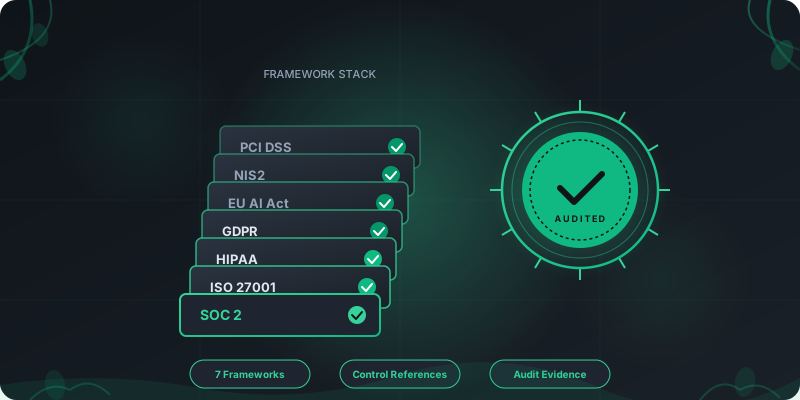
Each pillar covers what the framework requires for workforce awareness, the exact control references auditors check, the audit failure modes that trigger findings, and the exercise sequences that satisfy them.
By Last reviewed

Trust attestation

SOC 2

The AICPA attestation that names security awareness training as a Common Criterion and demands per-employee evidence across the audit period.

Read the framework guide
International ISMS standard

ISO 27001

The international ISMS standard that names security awareness as Annex A control 6.3 and binds awareness, competence, and per-employee evidence into the certification cycle.

Read the framework guide
Healthcare PHI compliance

HIPAA

The US healthcare privacy and security framework that makes workforce security awareness training a named Administrative Safeguard under §164.308(a)(5).

Read the framework guide
EU data protection regulation

GDPR

The EU data protection regulation that names employee training as a DPO duty under Article 39 and an organisational security measure under Article 32.

Read the framework guide
Card data security standard

PCI DSS

The Payment Card Industry Data Security Standard that governs every organization storing, processing, or transmitting cardholder data.

Read the framework guide
EU cybersecurity directive

NIS2

The EU cybersecurity directive that mandates cyber hygiene and security awareness training for essential and important entities, with personal liability for management bodies.

Read the framework guide
EU AI regulation

EU AI Act

The EU regulation that makes AI literacy training a legal duty for every provider and deployer of AI systems, with penalties up to €35M or 7% of global turnover.

Read the framework guide

How does compliance training work, and what do auditors actually look for?

Compliance training, in audit terms, is the documented program that proves an organization has educated its workforce on the security and privacy obligations a framework requires. SOC 2 Common Criterion 1.4, ISO 27001 Annex A 6.3, HIPAA §164.308(a)(5), PCI DSS Requirement 12.6, GDPR Article 39, NIS2 Article 21(2)(g), and EU AI Act Article 4 each demand the same artifact set: a defined program, role-based content, completion records per employee, and a refresh cadence that auditors can tie to a calendar.

The most common audit finding is not missing training. It is missing evidence. Organizations run an annual video, but cannot show which employees completed it, when, or how the content maps to the specific control area the auditor is testing. The Ponemon Institute 2024 Cost of a Data Breach Report found that organizations with structured security training programs paid 23% less per breach than those without.

Auditors test three things on every framework: scope (does the program reach all in-scope employees, contractors, and privileged roles), content (does it cover the threats and obligations the framework names), and evidence (timestamped per-employee records exportable to the auditor without manual reconstruction). The pillars below map each framework to those three requirements with the exact control references, audit failure narratives, and exercise sequences that satisfy them.

How we sequence framework coverage

The framework library is sequenced by the empirical buyer record, not by alphabetical order. SOC 2 leads because it is the dominant trust-attestation in the SaaS buying motion. ISO 27001 follows because it is the international ISMS standard certified to in 70+ countries and is contractually demanded by enterprise customers. HIPAA, PCI DSS, and GDPR sit beside each other because they are the three regulator-enforced regimes that already produce named penalties year over year, with documented training-failure findings.

NIS2 and the EU AI Act are newer but legally binding for in-scope entities across the European Union. NIS2 entered force October 2024 with personal liability for management bodies under Article 20 and a mandatory cyber-hygiene-and-training control under Article 21(2)(g). The EU AI Act AI literacy requirement under Article 4 took effect February 2025, applies to providers and deployers regardless of risk tier, and carries the regulation’s general penalty regime. We surface both because the controls are written, the deadlines are real, and most enterprises do not yet have a documented training program tied to either.

Each pillar follows the same structure: definition and scope, framework-specific training requirements with control references (e.g. SOC 2 CC1.4, HIPAA §164.308(a)(5), PCI DSS 12.6.3, NIS2 Art. 21(2)(g), EU AI Act Art. 4), audit failure modes drawn from named enforcement actions, the eight defensive controls that satisfy the framework, the role-based exercise sequence from the 100+ exercise catalogue that drills the human side, and a primary-source citation list. Auditors can cite the same primary sources the page does.

Frequently Asked Questions

How GRC and security leaders prioritize compliance training.

Which compliance framework should we tackle first?

For most enterprises, SOC 2 comes first because it is the trust attestation customers ask for during procurement. ISO 27001 follows when contracts demand a certified ISMS or when expansion into international markets requires it. HIPAA is non-negotiable for any organization touching protected health information; PCI DSS for card data; GDPR for any data of EU residents. NIS2 and the EU AI Act apply by sector and AI use respectively, with personal liability for the management body in NIS2.

Does the same training satisfy multiple frameworks?

Yes, when the program is mapped correctly. The same phishing exercise satisfies SOC 2 CC1.4, ISO 27001 A.6.3, HIPAA §164.308(a)(5), PCI DSS 12.6.3, NIS2 Art. 21(2)(g), and the GDPR Article 39 awareness duty in one assignment. The mapping is what makes one program double-count across multiple audits, which is the only way mid-market security teams keep up with overlapping obligations.

What evidence do auditors actually want to see?

Three artifacts on every audit. (1) The training program document: scope, content list, refresh cadence, role-based assignment logic. (2) Per-employee completion records with timestamps, exportable to PDF or CSV. (3) Evidence that the content matches the framework’s named requirements (the mapping table). RansomLeak ships all three out of the box, with exports formatted for SOC 2, ISO 27001, HIPAA, PCI DSS, NIS2, and EU AI Act audits.

How often does compliance training need to be refreshed?

Most frameworks specify "annually" as the floor, but every modern auditor expects ongoing reinforcement. SOC 2 and ISO 27001 auditors look for evidence of a continuous program (monthly micro-exercises beat one annual hour). NIS2 explicitly requires regular cyber-hygiene refreshers. The EU AI Act AI literacy obligation is ongoing as systems change. RansomLeak ships fresh content monthly so the cadence holds without repeating material.

How are these framework pillars different from the /compliance-mapping/ matrix?

The matrix is a single-page cross-reference: 13 frameworks, one table each, mapping requirement areas to courses and exercises. It is a quick reference for a buyer comparing scope. The framework pillars below go deeper on seven of those: definition, audit failure modes, named enforcement actions, control-by-control coverage, FAQs, and primary sources. Use the matrix to compare; use the pillar to defend the program in front of an auditor.

Build Audit-Ready Compliance Training

Book a 30-minute walkthrough. Tell us which frameworks you are audited against. We will scope the exercise sequence, the assignment logic, and the evidence export your auditor expects.