Human Risk Score
Give every person in your organization a 0 to 100 score that estimates how likely they are to fall for a social-engineering attack. It is built from how people actually behave in phishing simulations, not a questionnaire, and it moves as that behavior changes.
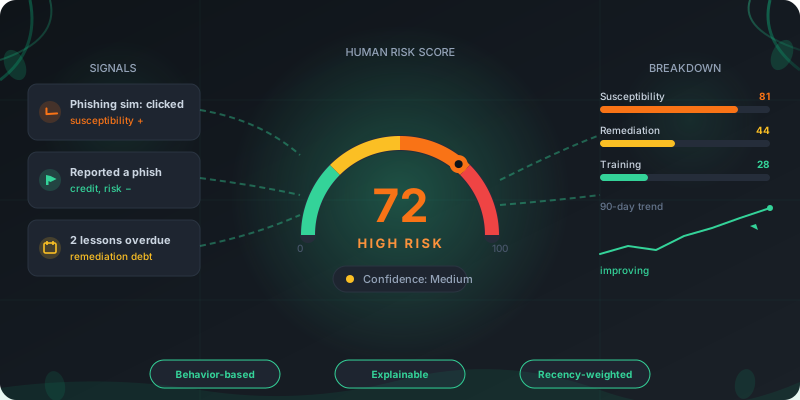
How the human risk score is calculated
Four steps from raw behavior to a number you can act on.
Collect signals
Every phishing simulation result, phish report, overdue lesson, and failed drill becomes a signal tied to the person who generated it. No surveys, no self-assessment.
Weight what predicts failure
Three sub-scores feed the total: susceptibility from simulation outcomes, remediation debt from overdue follow-ups, and training hygiene. Susceptibility carries the most weight because it tracks real failure.
Decay over time
Recent behavior counts most. Each signal fades on a roughly 90-day half-life, so a slip last week weighs more than one last year, and people who improve watch their score fall.
Score and band
Each person lands on a 0 to 100 score and a band: Low, Moderate, High, or Critical. People with too little history are flagged Limited data instead of being guessed at.
Every score shows its work
A risk number nobody can explain is a number nobody trusts. Each score opens to the evidence behind it.
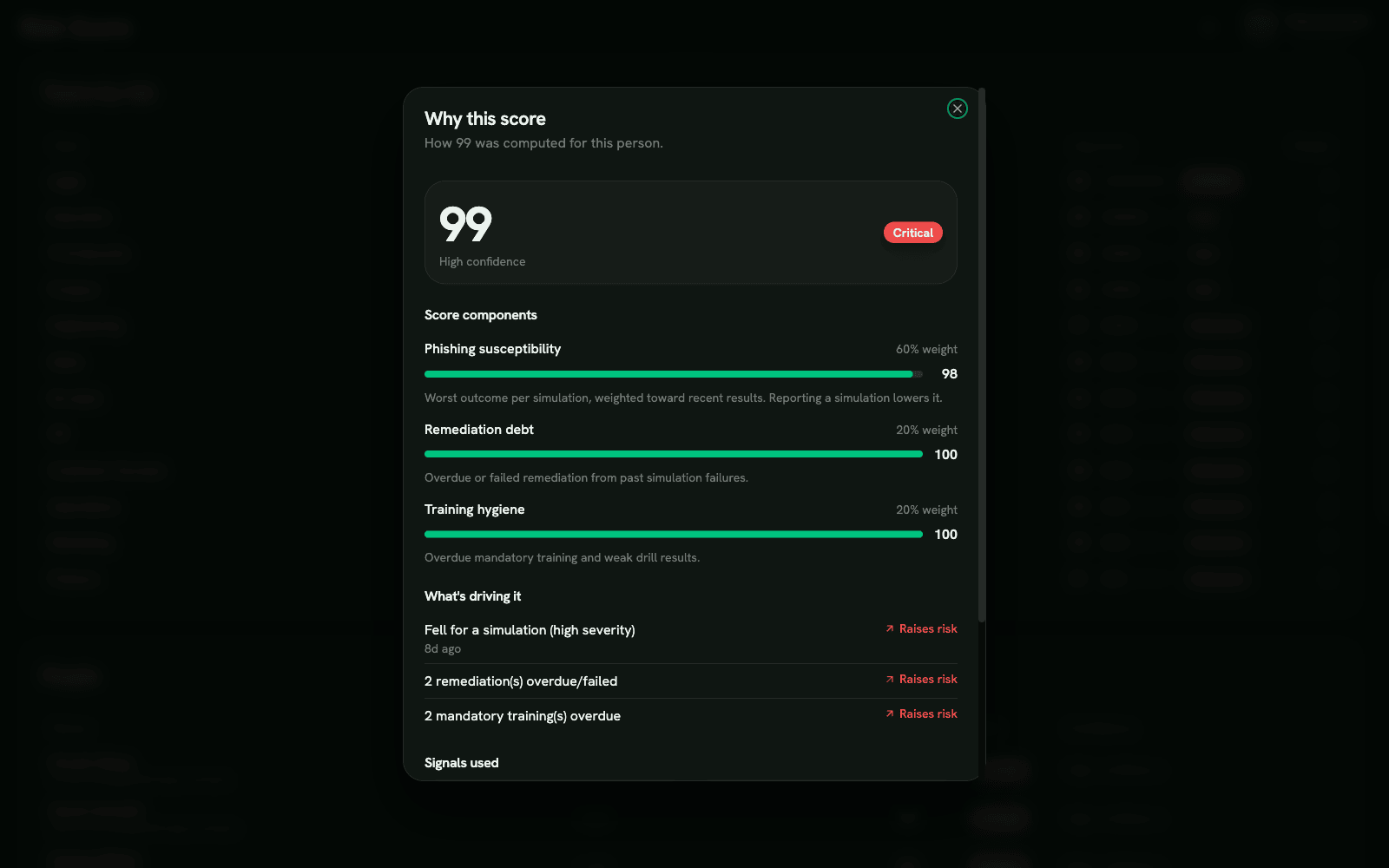
Top factors, in plain terms
Open any score to see the sub-scores, their weights, and the specific events pushing it up or down, like a clicked credential lure three weeks ago or two overdue lessons.
A confidence rating on every score
Each score carries a confidence level. People with little simulation history sit near a neutral baseline and are labeled Limited data, so a quiet new hire is never mistaken for a safe one.
No black box
Managers and admins can trace any score back to the exact simulations, reports, and lessons behind it. There is no hidden model output to take on faith.
Built from behavior, not guesswork
The score reads the decisions people make under a real lure, not data scraped from somewhere else.
Phishing-simulation outcomes
Opened, clicked, submitted credentials, opened an attachment, granted OAuth, or replied to a business-email-compromise lure. The worst action in each simulation sets the susceptibility score.
Reporting lowers risk
People who report a simulated phish get credit for it. Spotting and reporting an attack is the human firewall behavior you want, so the score rewards it.
Remediation and training debt
Overdue or failed follow-up training and overdue mandatory lessons raise the score until they are cleared. Finishing the work brings it back down.
See risk across the whole organization
Roll the score up from one person to a team to the entire workforce, and watch the trend instead of a single snapshot.
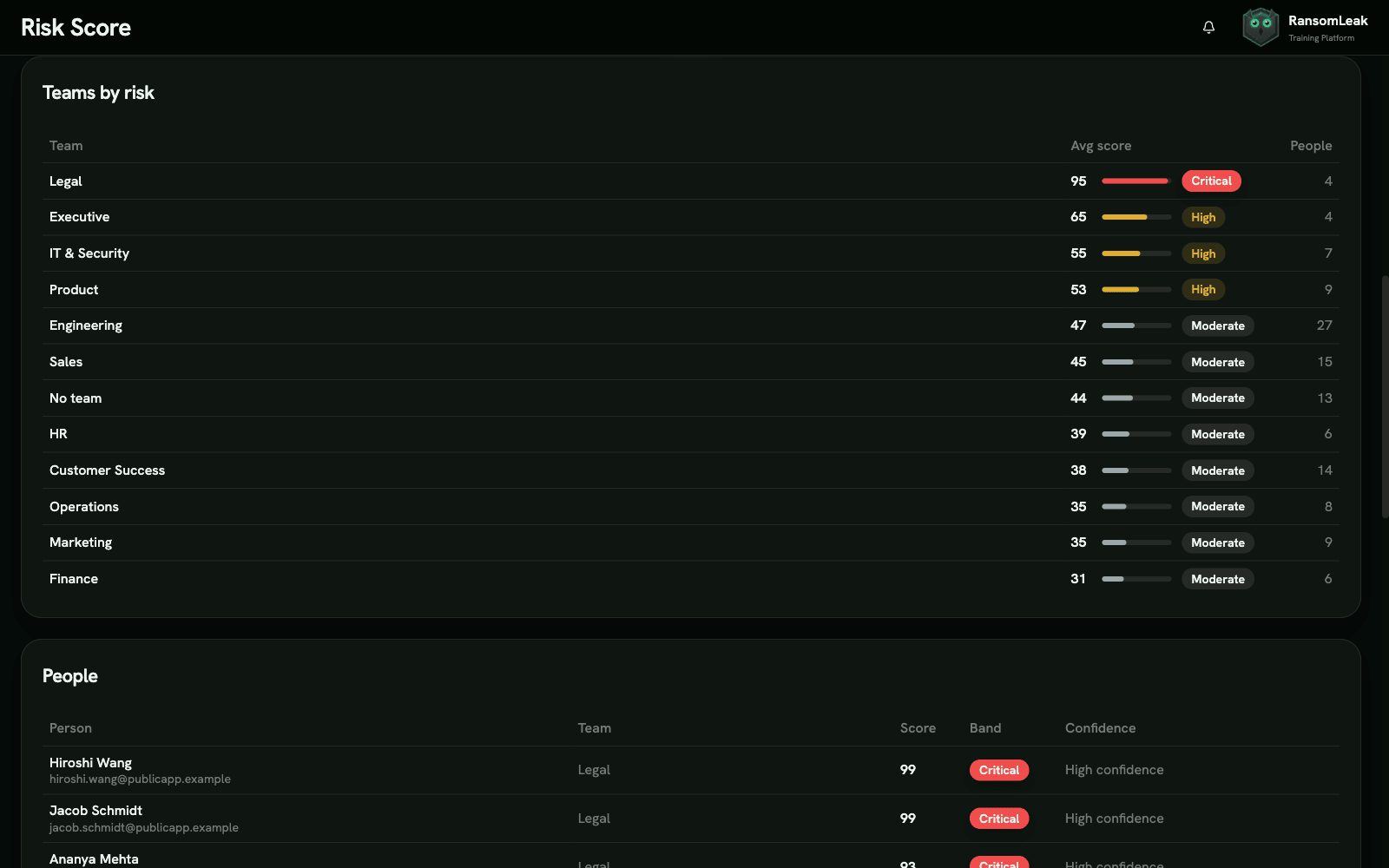
Org and team rollups
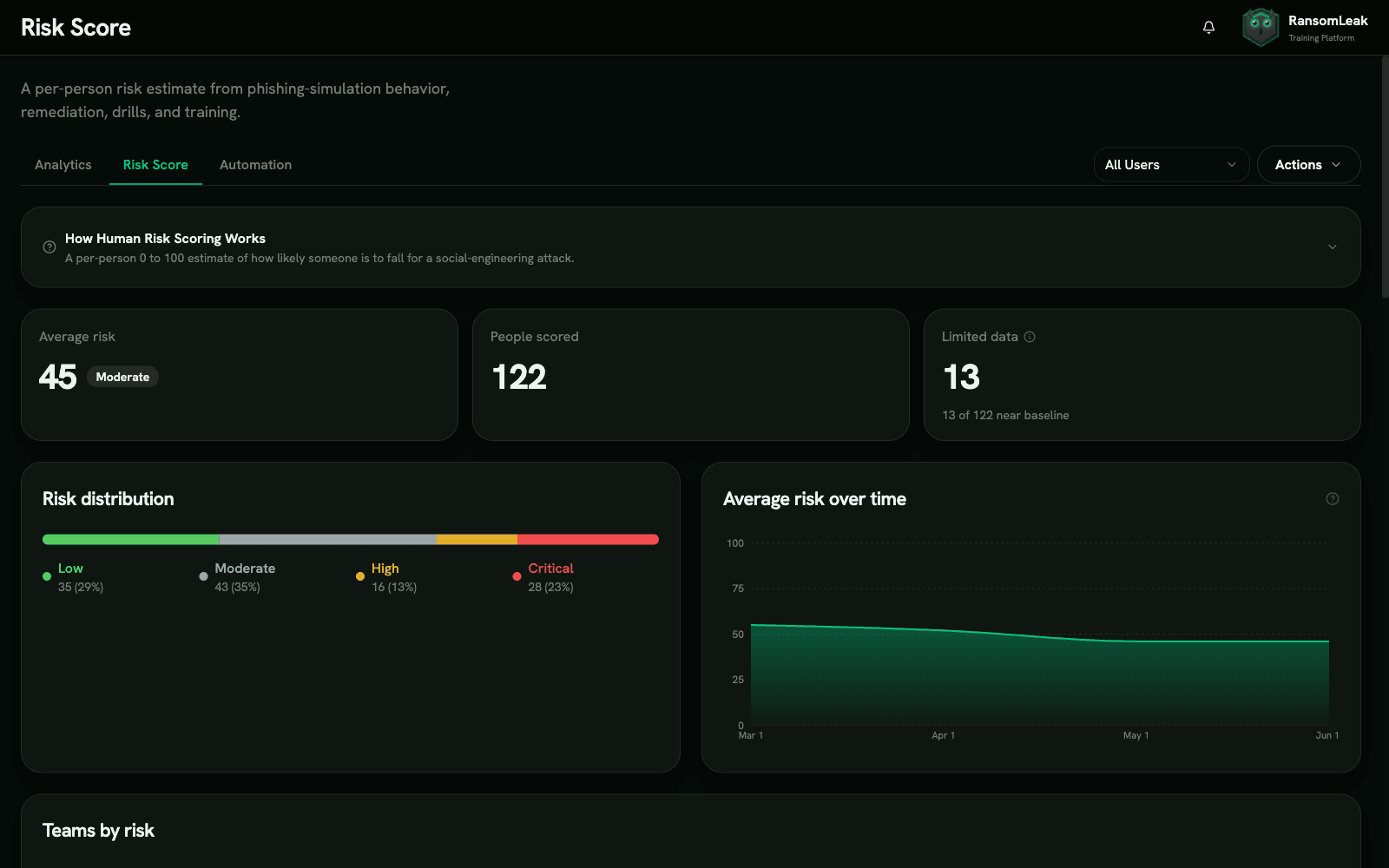
See the average score, the spread across Low to Critical bands, and the trend over time for the whole organization and for each team.
Find who needs attention
A roster sorted riskiest first puts the handful of people who actually move the number at the top, so a program manager knows exactly where to spend time.
Private by default
Managers see only their own direct reports. Individual scores are gated behind a permission, and everyone else sees aggregates, in line with works-council and GDPR expectations.
Frequently Asked Questions
What is a human risk score?
A human risk score is a number, usually on a 0 to 100 scale, that estimates how likely a specific employee is to fall for a social-engineering attack like phishing. A higher score means higher risk.
RansomLeak builds the score from how each person behaves in phishing simulations, whether they report suspicious messages, and whether their training and remediation are up to date. It is the measurement layer of broader human risk management.
Risk is not spread evenly across a workforce. A small group of repeat clickers accounts for most of the exposure, and the Verizon 2024 Data Breach Investigations Report found a human element in 68% of breaches, so scoring people individually lets you focus on the few who need attention.
How is the human risk score calculated?
Three sub-scores feed the total. Susceptibility comes from phishing-simulation outcomes, from opened through clicked to credential submitted. Remediation debt comes from overdue or failed follow-up training. Training hygiene comes from overdue mandatory lessons and failed drills.
Susceptibility carries the most weight because it tracks real failure, and every signal decays on a roughly 90-day half-life so recent behavior dominates. Admins can tune the weights, bands, and half-life to match their own risk model.
Does a higher score mean more or less risk?
Higher means riskier. A score near 100 marks someone who has recently failed simulations and has training debt, while a score near 0 marks someone who consistently spots and reports lures.
People sit in one of four bands, Low, Moderate, High, or Critical, so you can act on a band without arguing over single points.
Do you use dark web or OSINT data to score people?
No. The score is built from behavior inside your own program: simulation results, phish reports, and training status. It does not pull breach databases, social-media footprints, or other external profiling.
That keeps the score explainable and defensible. Every point traces back to an action the person took, which matters for works-council and privacy review.
How often does the score update?
Scores recompute every night, and they also update in near real time after a high-impact event such as submitting credentials to a simulated lure or completing a remediation path.
So a serious failure shows up the same day rather than waiting for the next campaign cycle.
Do I need phishing simulations to use the human risk score?
Yes. The score depends on real behavioral signals, and phishing simulations are the primary source. Without them there is no behavior to measure, so the human risk score is part of the simulation add-on rather than basic training alone.
Once it is running, you can act on it automatically with risk-based automation.
See RansomLeak in Action
Try the free exercises or book a demo to see analytics, SCORM export, SSO, and custom content in your environment.