
Shadow AI: Unauthorized AI Usage Problem
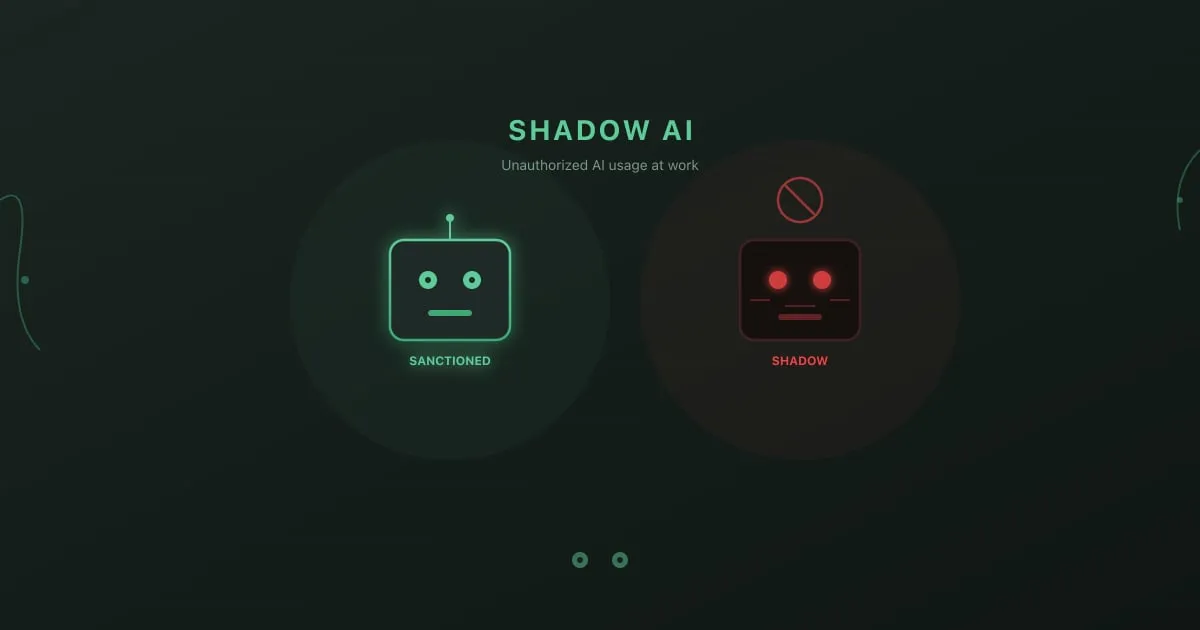
Shadow AI is what happens when an employee signs up for ChatGPT with a work email, pastes a customer list into a free Gemini tab, or asks Copilot to draft a security policy nobody has reviewed. The tool solves a real problem in minutes. The data leaves the building on the way. The security team has no idea it happened. That gap is the core of the shadow AI problem, and it is growing faster than any governance framework in place.
What is shadow AI?
Section titled “What is shadow AI?”Shadow AI is the use of artificial intelligence tools, models, or services inside an organization without the knowledge or approval of IT, security, or procurement. It includes consumer chatbots like ChatGPT, Gemini, and Claude, AI features baked into SaaS tools like Notion, Slack, and Zoom, browser extensions that call external models, personal API keys employees run against company data, and in-house models that a single team spins up without review.
Shadow AI is a subset of shadow IT, and it behaves the same way. Employees adopt the tool because it is faster than the official path. Security finds out later, usually because of an incident, an audit, or a curious DNS query. The difference from classic shadow SaaS is that AI consumes unstructured text, so the data leakage surface is wider, and the outputs are generated content that employees act on without a clear audit trail.
Why shadow AI is exploding
Section titled “Why shadow AI is exploding”The adoption curve for generative AI has no precedent in enterprise software. OpenAI reported 100 million weekly active users for ChatGPT in late 2023, and that line kept climbing through 2024 and 2025. Microsoft, Google, and every major SaaS vendor shipped AI features into products employees already use. The friction to adopt a new AI tool is usually one click or zero.
Four drivers make shadow AI harder to contain than earlier shadow IT waves.
Productivity is real. AI speeds up drafting, summarizing, coding, research, and analysis by real and measurable amounts for most knowledge work. Employees adopt AI because it pays back inside a single task, not after a quarter of onboarding.
Free tiers are good enough. ChatGPT, Gemini, and Claude all offer capable free tiers that run inside a browser tab. There is no purchase order, no IT ticket, no training requirement.
SaaS vendors enable it by default. Notion AI, Slack AI, Zoom AI Companion, and Microsoft 365 Copilot integrate into tools that employees already have. Sometimes the AI features are on by default, sometimes a single admin toggle enables them for the whole organization, often without a thoughtful data review.
LLMs trivialize custom tooling. A data analyst can wire an OpenAI API key into a Google Sheet and call it from a cell. A support lead can drop a chatbot widget onto a Zendesk macro. Individual builders are shipping shadow AI faster than any procurement process can reasonably respond.
The Unreviewed AI-Built App exercise follows one of those builds: a refunds dashboard an assistant wrote over a weekend, live on a public link with a payments key in its code.
Shadow AI risks by category
Section titled “Shadow AI risks by category”Shadow AI creates six risk categories worth tracking separately. Each maps to a control you probably already have for other SaaS, adjusted for the AI data path.
Data leakage. The biggest and most common risk. Employees paste confidential data into AI tools that retain it, train on it, or log it. The 2023 Cyberhaven analysis of 1.6 million workers found that 11% of the content pasted into ChatGPT was confidential, covering source code, customer data, and regulated information. Most of that use was shadow. See the AI data leakage deep dive for the fuller picture.
Compliance exposure. GDPR, HIPAA, SOC 2, PCI DSS, and most industry-specific frameworks require you to know your sub-processors and data flows. A shadow AI tool is a sub-processor you did not disclose, under terms you did not negotiate, processing data the regulator assumed you controlled. Auditors are now asking the question directly.
IP leakage. Proprietary code, unreleased strategy, customer lists, and trade secrets pasted into consumer AI tools leave the organization. Even when vendor terms promise not to train on the data, it still lives in prompt logs, crosses vendor infrastructure, and is accessible under defined circumstances to vendor staff.
Hallucination-driven errors. AI tools produce confident, plausible, incorrect outputs. When employees act on those outputs without verification, bad decisions follow. The 2023 Mata v. Avianca case in the Southern District of New York is the canonical example: a lawyer filed a brief citing six cases that ChatGPT invented. Similar patterns show up in medical notes, engineering specs, and financial summaries.
Cost sprawl. Shadow AI quietly builds a long tail of monthly subscriptions paid on personal cards, team cards, or through SaaS marketplaces. Individual costs are small, aggregate costs are not, and procurement loses the negotiating position it needs to demand enterprise terms with meaningful data protections.
Audit failures. When a SOC 2, ISO 27001, or HIPAA auditor asks which AI tools process regulated data and you do not have a clean answer, the audit finding is predictable. Shadow AI generates these findings without any incident needed.
Shadow AI in common SaaS products
Section titled “Shadow AI in common SaaS products”Some of the fastest-growing shadow AI is not a chatbot at all. It is a feature inside software employees already have.
Notion AI. Opt-in per workspace, with paid and free-trial access. Processes the contents of Notion pages, and by default may retain prompts for abuse monitoring per Notion’s current privacy docs. Organizations that enable it without a data review end up sending internal wiki content through OpenAI or Anthropic infrastructure.
Slack AI. Summarizes channels, threads, and documents. Admins can enable it at the workspace level, and the summaries process message content in real time. Salesforce publishes a Slack AI privacy page describing encryption and data handling, but shadow enablement by an enthusiastic admin still creates an undocumented data flow.
Zoom AI Companion. Generates meeting summaries, action items, and chat responses. Default settings have varied over time. In 2023, Zoom updated its terms to clarify that customer content is not used to train AI models, after public pushback. Organizations that do not actively review those settings still inherit whatever the defaults are today. Third-party AI notetakers add a less visible path. The Unapproved AI Notetakers exercise shows a bot joining a confidential HR meeting and sharing its recap through a public link.
Google Workspace Gemini. Integrated into Gmail, Docs, Sheets, and Meet. Enterprise licensing gives admin controls, but Gemini usage often lands in the tenant before data residency, retention, and regulated-content policies have been reviewed.
Microsoft 365 Copilot. Grounded in the user’s Microsoft Graph content, which is useful for reducing hallucination and keeping data inside the tenant boundary. The shadow risk is lower than consumer tools, but Copilot still surfaces data based on the user’s effective permissions, which exposes long-standing overshare problems in SharePoint and OneDrive. If your permissions hygiene is weak, Copilot is going to tell the whole company about it.
Browser and IDE extensions. GitHub Copilot in the IDE, Cursor, Continue, Windsurf, Grammarly AI, and a long tail of Chrome extensions read content from the tool they augment. Each one is an AI data path worth reviewing. Coding assistants also read files nobody handed them, as the AI Context Secret Leak exercise shows with a live key that ends up in a public pull request.
How to detect shadow AI in your organization
Section titled “How to detect shadow AI in your organization”You cannot govern what you cannot see. Four telemetry sources together cover most shadow AI.
DNS and network logs. Watch for traffic to chat.openai.com, api.openai.com, claude.ai, api.anthropic.com, gemini.google.com, chat.mistral.ai, api.together.ai, replicate.com, huggingface.co, and perplexity.ai. Add domains for any AI startup your industry is excited about this quarter. The list grows monthly, so make this a living policy.
CASB and SSE policies. Netskope, Zscaler, Microsoft Defender for Cloud Apps, and similar tools publish catalogs of AI services with risk ratings. Turn on inline monitoring for AI categories, then decide per domain whether to allow, block, or allow-with-DLP.
Expense and procurement data. Pull credit card transactions, expense reports, and SaaS marketplace invoices. Search for AI vendor names, API billing references, and the word “AI” in descriptions. This often surfaces paid shadow AI that network monitoring misses because it runs from personal devices.
DLP alerts on AI domains. Once you know the domains, add them to your DLP policy. Alert on paste of tagged data classes (source code, PII, payment data, PHI) to any AI domain. The first week of alerts is usually a wake-up call.
Employee surveys. A short, non-punitive survey per department about which AI tools they use, why, and what data they send often beats technical telemetry for coverage. People will tell you when the question is framed around “help us help you,” not around punishment.
Combine at least three of these sources. Any single one will miss something.
Shadow AI governance framework
Section titled “Shadow AI governance framework”Shadow AI does not vanish when you ban it. It moves to personal phones, home laptops, and hotspots. The governance programs that work combine a visible allow list with a clear approval path and ongoing training.
Allow list first, block list second. Publish a short list of approved AI tools with a one-line description of what each is approved for. Enterprise ChatGPT for general productivity. GitHub Copilot Business for code. Microsoft 365 Copilot for M365 content. Claude for Work for long-document work if that fits your stack. Employees looking for an option usually find the allow list first.
A fast approval process for everything else. Create a lightweight intake for new AI tools: tool name, use case, data classes, vendor terms review, and sign-off. Fast means two weeks, not two quarters. If the official path is faster than the shadow path, shadow use shrinks on its own.
Negotiate enterprise contracts aggressively. Every major AI vendor offers enterprise tiers with no training on prompts, configurable retention, SSO, DLP connectors, and SOC 2 reports. Those tiers cost more than consumer subscriptions, and they cost less than one serious incident. Bundle licensing with procurement reviews so the right tier lands on every eligible employee.
Build training that reflects current reality. The AI Security catalogue includes exercises on AI data leakage, prompt injection, Safe GenAI Usage, unapproved consumer AI tools, what personal data may go into a prompt, AI-powered phishing, and the OWASP LLM Top 10. Short, scenario-based training sessions beat long videos and policy PDFs.
Plan an incident response path for AI. Assume a prompt injection exfiltrates a mailbox, an employee leaks regulated data through a chat tool, or a hallucinated output causes a customer-facing error. Rehearse who pages who, who calls the vendor, who notifies the regulator. Every tabletop you run now lowers response time later.
Review the program quarterly. AI vendor terms, product features, and defaults change frequently. Put a recurring calendar event on the CISO and CPO calendars to re-read the privacy pages of every approved tool. The program that worked last quarter may not match what the vendor is promising today.
The NIST AI Risk Management Framework 1.0 is a helpful scaffold for larger programs, as are the ISO/IEC 42001 AI management system standard and the OWASP LLM Top 10 if you are mapping technical controls. None of those replaces the core operational pattern: visibility, allow list, approval path, training, incident drills, review.
Training employees to report AI use responsibly
Section titled “Training employees to report AI use responsibly”The best shadow AI programs treat employees as allies, not suspects. People who feel punished for disclosing a tool they were already using will stop disclosing.
Three cultural moves pay off.
Make reporting easy and safe. One short form. One promise of no retaliation for good-faith disclosure. Public recognition for the people who flag shadow AI they introduced. A human firewall culture shows up in the number of voluntary reports, not in the number of people who got in trouble.
Close the loop. When an employee reports a tool, respond. Either add it to the allow list, start the review, or explain the risk. Silence teaches people that reporting is pointless.
Tell them what happened after an incident. Share sanitized postmortems of AI-related incidents. When employees see concrete examples, the abstract policy becomes real. Shared learning compounds.
Pair that culture with the AI-specific training your team actually needs. The AI Security catalogue covers the patterns. The AI data leakage guide covers the single biggest risk. The ChatGPT security risks deep dive covers the tool most people are already using.
What is the difference between shadow IT and shadow AI?
Section titled “What is the difference between shadow IT and shadow AI?”Shadow IT is the use of any unauthorized tool, including cloud storage, SaaS apps, and personal devices. Shadow AI is the subset that involves AI tools or AI features embedded in other tools. The data leakage surface is wider because AI consumes unstructured text and generates content employees act on.
Why is shadow AI so dangerous?
Section titled “Why is shadow AI so dangerous?”Shadow AI combines data leakage, compliance exposure, IP risk, hallucinated outputs, cost sprawl, and audit failures in one pattern. The tools are trivially easy to adopt, and the data paths are often invisible to security tooling that was configured before AI arrived.
How common is shadow AI?
Section titled “How common is shadow AI?”Very. Gartner projects that by 2027, roughly 75% of employees will acquire or modify technology outside IT’s visibility. Cyberhaven’s 2023 research found 11% of content pasted into ChatGPT was confidential. Every recent CISO survey lists AI governance in the top five priorities.
Can DLP detect shadow AI?
Section titled “Can DLP detect shadow AI?”DLP catches some shadow AI, specifically paste and upload of tagged data classes to known AI domains from managed devices. It misses unmanaged devices, mobile apps, and novel AI services your DLP vendor has not categorized yet. Combine DLP with DNS logging, CASB, and expense reports for coverage.
What is the first step to reducing shadow AI?
Section titled “What is the first step to reducing shadow AI?”Publish an allow list. Before you try to block anything, tell employees which AI tools are approved and for what. Most shadow AI comes from people who could not find an approved path.
Should we ban ChatGPT?
Section titled “Should we ban ChatGPT?”A blanket ban tends to push usage underground rather than stopping it. A better pattern is to deploy ChatGPT Enterprise or a peer product, route access through your identity provider, apply DLP to AI domains, and provide clear guidance on what data is acceptable to send.
How do I train employees on shadow AI?
Section titled “How do I train employees on shadow AI?”Short scenario-based exercises work better than policy PDFs. The AI Security catalogue has ready-made exercises on AI data leakage, prompt injection, and AI-driven social engineering. Pair those with a quarterly refresher on your current allow list.
How does shadow AI affect audits?
Section titled “How does shadow AI affect audits?”Auditors for GDPR, HIPAA, SOC 2, and ISO 27001 now ask directly about AI tools that process regulated data. Any AI processing not documented in your sub-processor list, data flow diagrams, and access reviews is a likely finding. Cleaning up shadow AI before audit season is cheaper than remediating the finding.
Bottom line
Section titled “Bottom line”Shadow AI is shadow IT with a wider blast radius. The tools are free, the adoption curve is vertical, and the data leaks quietly. Regulators, auditors, and your own risk register are catching up fast.
Visibility plus an allow list plus training plus incident drills beats any single heroic control. If you are ready to take the first step, pair the AI Security catalogue with the AI data leakage guide, then move the organization off free-tier consumer accounts over the next quarter.
Sources
Section titled “Sources”- Cyberhaven: 11% of data employees paste into ChatGPT is confidential, 2023
- Gartner: Business technologist trends and forecast
- NIST AI Risk Management Framework 1.0
- ISO/IEC 42001 AI Management System Standard
- OWASP Top 10 for LLM Applications 2025
- Stanford HAI 2024 AI Index Report
- OpenAI Enterprise Privacy
- Mata v. Avianca, Inc., 1:22-cv-01461 (S.D.N.Y. 2023)
- Verizon 2024 Data Breach Investigations Report
- Zoom AI Companion privacy update, August 2023