
Preparing Employees for ISO 27001 Audits
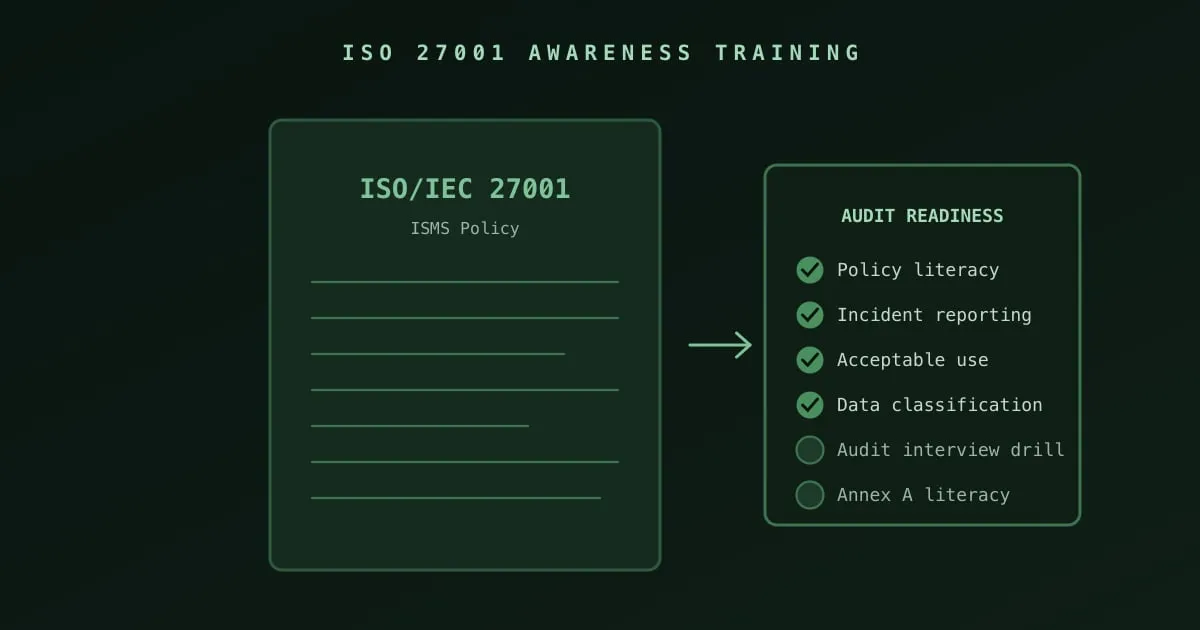
A new auditor sits across from a customer-success manager and asks one question: “Where would you find the acceptable-use policy for email?” The manager stares at the screen, opens the intranet, and quietly admits she is not sure which of three documents is current. Her company is halfway through an ISO 27001 Stage 2 audit.
This conversation repeats, in slightly different forms, at every ISO 27001 certification. It is not a compliance failure. It is an awareness failure, and it costs organizations real certifications when auditors decide the information security management system exists on paper but not in practice.
What is ISO 27001 awareness training?
Section titled “What is ISO 27001 awareness training?”ISO 27001 awareness training is structured education that teaches employees the policies, responsibilities, and daily behaviors an organization commits to under the ISO/IEC 27001 information security management standard. It covers acceptable use, incident reporting, data classification, and the questions auditors ask employees during certification interviews.
The goal is not recitation but readiness. Any employee, at any moment in the audit window, should be able to describe the policies that apply to them and point to where those policies live.
Clause 7.3 of ISO/IEC 27001:2022 makes awareness a mandatory control. Organizations must ensure that every person performing work under their control is aware of the information security policy, their contribution to the ISMS, the implications of non-conformance, and the benefits of improved performance.
Auditors interpret “aware” literally. They pick employees at random and ask them. This is different from broad compliance training that surveys multiple frameworks at once, because ISO 27001 requires depth on one specific management system including the evidence trail that shows the system is alive.
For the Annex A 6.3 framework breakdown end-to-end, see our ISO 27001 awareness training framework guide. This post focuses on the audit-prep angle: the questions certification bodies actually ask.
Who needs ISO 27001 training in an organization?
Section titled “Who needs ISO 27001 training in an organization?”Everyone who performs work under the organization’s control. Clause 7.3 does not exempt contractors, temporary staff, or agency workers. If they read company email or touch company data, they are in scope.
In practice, organizations running a real ISMS split the audience into three bands. All staff receive baseline awareness: what the acceptable-use policy requires, how to report security events, and where the ISMS documentation lives. Role-specific staff receive deeper content, for example HR on joiner-mover-leaver controls, developers on secure development, and procurement on supplier vetting.
Managers receive an audit-mindset briefing that prepares them to represent their team in front of an auditor. Evidence of each band lives in the training records the auditor will sample. If records for contractors are missing, that is a finding.
What topics does ISO 27001 awareness training cover?
Section titled “What topics does ISO 27001 awareness training cover?”The 2022 revision of ISO/IEC 27001 reorganized Annex A into four themes: organizational, people, physical, and technological. Awareness training touches each theme at a practical level rather than reading the standard aloud.
Organizational controls show up as policy literacy and an understanding of each employee’s own security responsibilities. People controls include background screening, confidentiality, and the disciplinary process, most of which are familiar from HR onboarding but need to be re-surfaced explicitly in the ISMS context.
Physical controls cover clear-desk practice, secure disposal, and visitor management. Technological controls translate into day-to-day habits: MFA, cautious link-clicking, data classification, and secure remote work.
A good training program does not lecture on all of Annex A at once. It sequences the controls to the employee’s real workflow and revisits them in short, scenario-based modules throughout the year.
How do you prepare employees for an ISO 27001 audit?
Section titled “How do you prepare employees for an ISO 27001 audit?”Auditors do not quiz staff on clause numbers. They observe behavior, ask for evidence, and interview a sample of employees. Preparation means rehearsing the three moments that go wrong most often.
First, the “show me” moment. An auditor asks where the information security policy lives. Employees should be able to open it within ten seconds from any device they work on.
Second, the “what would you do” moment. An auditor describes a scenario, such as a lost phone, an unexpected USB drive, or a suspicious attachment, and listens for the reporting path. This is where audit-portal drills make the difference between a smooth conversation and a finding.
Third, the traceability moment. An auditor asks an employee to describe a recent change to a system and then checks whether the change actually follows the documented process. If the employee improvises, the finding is recorded against the ISMS.
Our privacy and compliance catalogue includes immersive scenarios for each of these moments, so staff practice the response before the audit rather than during it.
How often should ISO 27001 awareness training run?
Section titled “How often should ISO 27001 awareness training run?”Annually is the floor, not the target. ISO/IEC 27001 requires awareness to be “appropriate to the function”, which auditors increasingly read as continuous and contextual rather than a single session per year.
Mature programs refresh short modules every month, tie training to events such as new hires, policy updates, and incidents, and measure comprehension through scenario-based assessments rather than multiple choice. The security awareness training guide goes deeper on cadence and formats. For ISO 27001 specifically, keep the records granular enough to show who did what and when, because that record is the evidence the auditor will sample.
Organizations already running a GDPR employee training program often find their ISO 27001 content overlaps on acceptable use, incident reporting, and third-party handling. Building them as a single awareness backbone saves effort and tightens both audit trails. EU teams within scope of the NIS2 directive should map the same modules against NIS2 management-accountability and incident-reporting obligations, and US healthcare organizations can reuse the incident-reporting and acceptable-use content as the core of a HIPAA security awareness training program.
What does audit-ready look like in practice?
Section titled “What does audit-ready look like in practice?”When an auditor walks into a mature ISO 27001 program, three signals stand out. Employees talk about policies by name rather than as “that training module”. They can show where the policy lives in under ten seconds.
When asked about a scenario they have not personally encountered, they describe the reporting path first and the technical response second. That order is the difference between a clean finding and a conversation that drags a full morning of the audit window.
If your ISMS is approaching a Stage 2 audit or a surveillance review, book a walkthrough with our team to see immersive training that rehearses the moments your auditor will actually test.