
Security Awareness Training Pricing 2026
Most security awareness vendors will not show you a price page. They want a demo, a discovery call, and a scored account before a number leaves the room.
Security awareness training pricing is the per-user annual fee organizations pay to license cybersecurity education, phishing simulations, and compliance modules for employees. List prices typically range from $5 to $50 per user per year. Costs vary by vendor, content format, simulation depth, and contract length, and most vendors do not publish public pricing. Simulation depth is usually the biggest swing factor: see what a full phishing simulation program actually covers.
Prefer to see the content first? The security awareness exercise catalogue has 200+ interactive scenarios free to try without signup.
This post focuses on pricing math. For the full security awareness training context, see our Security Awareness Training Guide; for vendor-by-vendor positioning, see the Best Platforms for 2026 roundup; for ROI math, see the effectiveness research.
How much does security awareness training cost per user?
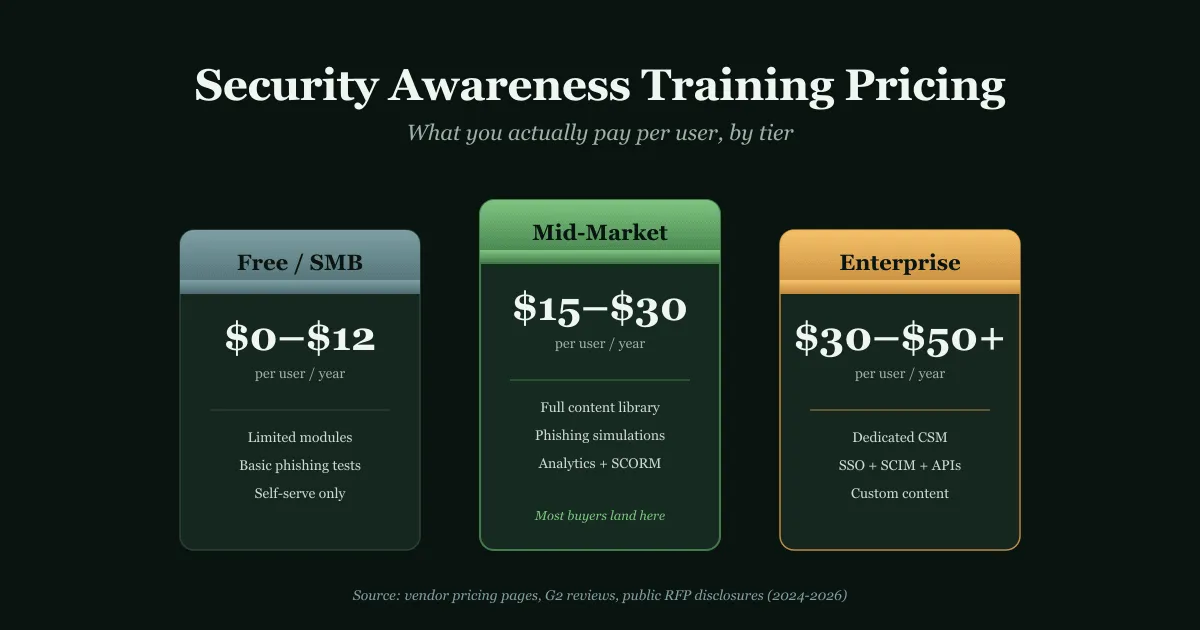
Section titled “How much does security awareness training cost per user?”Public per-seat pricing across the category falls into three bands. SMB and freemium plans run $0 to $12 per user per year. Mid-market plans run $15 to $30 per user per year.
Enterprise plans run $30 to $50 per user per year, with discounts at higher seat counts and longer terms.
These ranges hold across G2 review disclosures, vendor pricing pages where they exist, and procurement post-mortems published by buyers. The 2024 Gartner Magic Quadrant for Security Awareness Computer-Based Training treats anything above $40 per user per year as premium-positioned. The 2024 Verizon Data Breach Investigations Report puts the human element at 68% of breaches, which is the buying pressure that justifies the spend.
KnowBe4 publishes tiered list pricing (Silver, Gold, Platinum, Diamond) with a quote calculator on its site, though final pricing depends on seat count and contract length. Hoxhunt, SoSafe, Living Security, CybSafe, and Proofpoint Security Awareness all run quote-only.
Wizer offers a free baseline, with paid tiers starting at the low end of the SMB band. RansomLeak’s 200+ interactive exercises are free to try without signup; paid deployments are quoted based on seat count and feature scope.
For organizations under 500 seats, expect entry-level annual contracts in the $5,000 to $15,000 range. For 500 to 5,000 seats, expect $15,000 to $100,000. For 5,000+ seats, custom annual contracts of $50,000 to $500,000 are typical, before implementation fees and add-on modules.
Why do most security awareness vendors hide their pricing?
Section titled “Why do most security awareness vendors hide their pricing?”Hidden pricing is a deliberate choice, not a website oversight. Vendors run quote-only sales because list-price visibility erodes deal size at the top of the market.
Three forces drive the opacity. Enterprise sales teams price on willingness to pay, and a public list lets buyers anchor low before the discovery call ever happens. Investor pressure on net retention pushes vendors to capture as much budget as possible per deal.
Competitive intelligence cuts both ways. KnowBe4 raises prices on enterprise renewals at rates above the SMB list, and Hoxhunt sells at a premium to its public reviews. A list page would freeze that flexibility.
The result is asymmetric information at the buyer’s expense. Three buyers of identical platforms, identical seat counts, and identical feature sets can pay 2x or 3x different rates depending on negotiation, urgency, and AE quota cycle. Procurement teams that benchmark across G2 reviews, peer Slack groups, and competitive vendor quotes typically land 25% to 40% below the first verbal offer.
If you want a side-by-side that breaks the opacity for one vendor, the RansomLeak vs KnowBe4 comparison walks through specific feature and pricing differences. For a broader market scan, the best security awareness training of 2026 covers eight platforms with public price ranges where available.
What factors determine the price of security awareness training?
Section titled “What factors determine the price of security awareness training?”Six variables explain most of the variance between quotes for the same headcount.
Seat count and tier. Per-user pricing typically drops 15% to 30% between the 500-seat and 5,000-seat thresholds. Above 10,000 seats, expect another 10% to 20% discount. Smaller orgs pay the rate-card high end.
Contract length. Annual contracts list at one rate; two-year and three-year contracts earn an additional 10% to 20% discount. Multi-year terms also lock the vendor against per-seat price increases at renewal, which average 8% to 15% annually across the category.
Content depth. Base packages include core phishing and awareness modules. Add-ons (deepfake training, GDPR detail, role-based content, custom-branded scenarios, executive-targeted modules) push the per-user rate up 30% to 100%. The MGM Resorts security breach exercise is the kind of incident-based content typically priced as a premium module elsewhere; RansomLeak ships it in the base catalogue.
Phishing simulation cadence. Monthly simulation campaigns are standard. Weekly campaigns and continuous simulation engines (Hoxhunt’s flagship feature) push pricing up. SANS Security Awareness Reports recommend at least monthly touchpoints, so this is rarely a feature you can drop.
Integrations and SSO. SAML SSO, SCIM provisioning, Microsoft 365 connectors, and Slack integrations are sometimes paywalled at the enterprise tier. Mid-market plans that exclude SSO end up costing more in IT effort than they save on license fees.
Support model. Self-service support is included. Dedicated customer success management (CSM) is bundled at enterprise tiers and unbundled below. CSM-led deployments cut time-to-value but add 10% to 25% to the contract.
How do free, mid-market, and enterprise pricing tiers compare?
Section titled “How do free, mid-market, and enterprise pricing tiers compare?”Tiering across the SAT category is more consistent than the headline numbers suggest. Here is what each band actually delivers.
Free and SMB ($0 to $12 per user per year). Wizer, KnowBe4’s free phishing test, and a handful of freemium tools sit here. Expect a starter content library, basic phishing tests without true automation, and self-service support. Suited to teams under 100 employees with no compliance audit obligations.
The free security awareness training post breaks down 12 free options by content quality.
Mid-market ($15 to $30 per user per year). Full content libraries, monthly phishing simulations, completion analytics, and SCORM export. KnowBe4 Silver, SoSafe Standard, NINJIO, and RansomLeak’s standard tier sit here. Suited to teams from 100 to 2,000 employees with quarterly board-level reporting obligations.
Enterprise ($30 to $50+ per user per year). Dedicated CSM, SSO and SCIM, custom content, AI threat modules including MFA fatigue attack training and deepfake response, and bespoke role-based paths. KnowBe4 Platinum and Diamond, Hoxhunt’s flagship tier, SoSafe Premium, Proofpoint Security Awareness, and RansomLeak’s enterprise package sit here.
Suited to regulated industries, multi-region deployments, and orgs with audit obligations under SOC 2, ISO 27001, HIPAA, PCI DSS, or NIS2.
Volume discounts above 5,000 seats reshape the math. A 10,000-seat enterprise contract often lands at the upper end of the mid-market rate per user, not the headline enterprise rate. Procurement negotiation matters as much as tier choice.
What does each vendor actually charge?
Section titled “What does each vendor actually charge?”Most of this category is quote-only, so the table below separates what vendors publish from what buyers report. Anything marked quote-only has no public figure, and we have not estimated one.
| Vendor | Published pricing | What buyers report |
|---|---|---|
| KnowBe4 | Tiered list (Silver, Gold, Platinum, Diamond) with a quote calculator | Roughly $1.50 to $3.25 per user per month on annual terms |
| Cofense | Entry pricing published through reseller listings | From about $10 per seat per year |
| Wizer | Free tier published, paid tiers listed | Paid plans under $2 per user per month |
| CanIPhish | Free tier plus pay-as-you-go published | Usage-based, lowest entry cost in the category |
| NINJIO | Quote-only | Per-user annual contracts, mid-market band |
| Hoxhunt | Quote-only | Premium band among pure-play human risk vendors |
| SoSafe | Quote-only | Mid-market to enterprise band, annual contracts |
| CybSafe | Quote-only | Premium band, enterprise contracts |
| Proofpoint Security Awareness | Quote-only | Usually negotiated inside a wider suite contract |
| Living Security | Quote-only | Enterprise band, Fortune 1000 buying motion |
| MetaCompliance | Quote-only | Mid-market to enterprise, UK and EU focused |
| Huntress (Curricula) | Quote-only | Bundled per-seat through the MSP channel |
| usecure | Quote-only | Per-seat through MSP partners, SMB band |
| Phished | Quote-only | Mid-market to enterprise, annual contracts |
| RansomLeak | Full exercise catalogue free to try, no account | Custom quote by seat count and feature scope |
How much does KnowBe4 cost?
Section titled “How much does KnowBe4 cost?”KnowBe4 is the only major vendor that publishes tier structure openly. Public reviews and procurement writeups place the effective rate at roughly $1.50 to $3.25 per user per month, which works out to about $18 to $39 per user per year on annual terms.
Silver covers training and phishing simulation. Gold adds monthly content and more reporting. Platinum and Diamond add advanced features including PhishER-adjacent tooling and AI Defense Agents. Seat count and contract length move the number more than tier choice does above a few thousand seats.
Why Hoxhunt and NINJIO look cheaper or dearer than they are
Section titled “Why Hoxhunt and NINJIO look cheaper or dearer than they are”Hoxhunt sits in the premium band, but it covers phishing rather than the full awareness obligation. Teams that also need compliance content buy a second platform, and the combined figure often exceeds a single broader vendor. NINJIO prices in the mid-market band for short-form video, which is inexpensive per module and expensive per behavior change if completion is not your actual problem.
The comparison that matters is cost per outcome, not cost per seat. Our fifteen-platform comparison matrix scores each vendor on what the license actually includes.
What hidden costs should buyers expect beyond the per-seat license?
Section titled “What hidden costs should buyers expect beyond the per-seat license?”The per-user license is the headline number, not the total cost.
Implementation and onboarding. Most enterprise deployments include a setup fee of $2,500 to $25,000 depending on platform complexity, SSO integration scope, and content customization. Some vendors waive this for multi-year contracts; some bill it as a separate professional services line.
Add-on modules. Phishing simulation libraries, compliance courseware (GDPR, HIPAA training, broader compliance training packs), and AI threat content are commonly priced as separate SKUs. A platform listed at $20 per user per year can land at $35 once the AI threat add-on and compliance pack are added.
Custom content development. Branded scenarios, executive-targeted content, and industry-specific modules typically cost $5,000 to $50,000 per piece. The invoice payment fraud exercise is one example of finance-team-specific content that earns its place in mature programs; building equivalent custom content runs into five figures.
Premium support. 24/7 support, named CSM, and quarterly business reviews are typically enterprise-tier inclusions but get unbundled at mid-market pricing.
Renewal escalation. Annual price increases of 8% to 15% are common at renewal. Multi-year contracts cap this. Single-year contracts expose buyers to it.
Lost productivity from poor content. This is the largest hidden cost most buyers ignore. The IBM 2024 Cost of a Data Breach Report puts the global average breach cost at $4.88 million. A training program that fails to change behavior leaves that risk on the table. The cheapest license is not the cheapest program.
For technical teams that need endpoint patching and EDR alert training, make sure role-based content is included rather than billed as a custom-development add-on. This is a frequent gotcha at the mid-market tier.
How to estimate your total security awareness training cost in 2026
Section titled “How to estimate your total security awareness training cost in 2026”A repeatable estimation method beats vendor-quote shopping. Use this five-step framework before the first sales call.
- Count seats. Active employees plus contractors with corporate email access. Round up.
- Pick a tier. Match your compliance obligations (SOC 2, ISO 27001, HIPAA, NIS2) and reporting needs to the SMB, mid-market, or enterprise band.
- Identify required add-ons. Phishing simulation cadence, AI threat content, custom branding, role-based paths, compliance courseware.
- Estimate implementation. Add 10% to 20% of year-one license for setup, SSO integration, and content customization.
- Forecast renewals. Add 10% per year for years two and three. Negotiate a multi-year cap to flatten this.
For a 1,000-seat mid-market deployment, the math typically runs $22 per user × 1,000 seats = $22,000 in license, plus $5,000 in implementation, plus a $10,000 AI threat add-on. Year-one total: $37,000. Three-year total without escalation cap: $122,000.
Is RansomLeak pricing different from competitors?
Section titled “Is RansomLeak pricing different from competitors?”RansomLeak’s training is interactive simulation-first, not video-and-quiz. That changes the cost equation in three ways.
The full 200+ exercise catalogue runs without signup, so buyers evaluate content before the sales call, not after. This shortens evaluation cycles by weeks.
Pricing is quoted against the same tier bands above. Smaller seat counts are not penalized with disproportionate per-user rates.
SCORM export is standard at mid-market and above. Organizations with existing LMS infrastructure (Cornerstone, Workday Learning, SuccessFactors, Moodle) deploy RansomLeak content as SCORM packages and skip paying for cloud features they will not use.
Frequently asked questions
Section titled “Frequently asked questions”How much does security awareness training cost per user per year?
Section titled “How much does security awareness training cost per user per year?”Public per-seat pricing falls into three bands: SMB and freemium plans at $0 to $12, mid-market plans at $15 to $30, and enterprise plans at $30 to $50+ per user per year. Discounts apply at higher seat counts and longer contract terms.
Why do KnowBe4, Hoxhunt, and SoSafe hide their pricing?
Section titled “Why do KnowBe4, Hoxhunt, and SoSafe hide their pricing?”Enterprise vendors run quote-only sales because public list pricing erodes deal size and removes negotiation flexibility. Three buyers of identical platforms can pay 2x or 3x different rates depending on procurement strength. Buyers who benchmark across G2 reviews, peer groups, and competitive vendor quotes typically land 25% to 40% below the first verbal offer.
Is there free security awareness training that actually works?
Section titled “Is there free security awareness training that actually works?”Yes. Wizer offers a free baseline tier for small teams, and RansomLeak’s 200+ interactive exercises are free to try without signup and represent the same content paying customers receive. Marketing-driven free tools from larger vendors (such as KnowBe4’s Phishing Test) are lead magnets, not full training programs.
What is a fair price for enterprise security awareness training?
Section titled “What is a fair price for enterprise security awareness training?”For 1,000 to 5,000 seats, a fair total annual contract lands in the $15,000 to $75,000 range, depending on add-ons and contract length. For 5,000+ seats, expect $50,000 to $500,000 with multi-year terms. Anything above $50 per user per year for a 5,000-seat deployment is overpriced unless the vendor is delivering custom content development.
What does security awareness training implementation cost?
Section titled “What does security awareness training implementation cost?”Implementation fees run $2,500 to $25,000 for enterprise deployments, depending on SSO integration complexity, content customization, and the number of locales required. Some vendors waive implementation for multi-year contracts; others bill it separately. Confirm in writing before signing.
How do I avoid renewal price hikes?
Section titled “How do I avoid renewal price hikes?”Lock in a multi-year contract with a renewal cap of 5% or less. Annual contracts are the most expensive form of SAT because vendors raise prices 8% to 15% annually. Three-year contracts with a 5% cap typically save 15% to 25% over three single-year renewals.
Does SCORM export change the pricing math?
Section titled “Does SCORM export change the pricing math?”Yes. SCORM-packaged content lets organizations with an existing LMS (Cornerstone, Workday Learning, SuccessFactors, Moodle, Docebo) avoid paying for the vendor’s cloud platform features they will not use. RansomLeak, SoSafe, NINJIO, CybSafe, Living Security, and MetaCompliance all support SCORM; Hoxhunt does not.
What is the cheapest way to start a security awareness program?
Section titled “What is the cheapest way to start a security awareness program?”Pair a free baseline (Wizer or RansomLeak’s free catalogue) with a paid phishing simulation tool for the first six months. Measure click rates, report rates, and time-to-report. Use that data to scope a paid platform contract from a position of evidence rather than guesswork.
Skip the demo gauntlet
Section titled “Skip the demo gauntlet”Run an exercise yourself before you talk to anyone. The exercise library is open, free, and takes 5 to 10 minutes per scenario.
For a written quote, contact our team with your seat count and compliance scope. We return a number within one business day.