ISO/IEC 42001 security awareness training
ISO/IEC 42001 is the certifiable standard for an AI management system. Clauses 7.2 and 7.3 ask you to prove that the people who build and run your AI know what they are doing.
Five-to-ten-minute 3D exercises mapped to each ISO/IEC 42001 duty, with completion evidence your auditor can export.
At a glance
- Standard
- ISO/IEC 42001:2023, first edition, December 2023
- Training clauses
- 7.2 Competence and 7.3 Awareness
- Assurance
- Third-party certification audits, not fines
- EU AI Act
- Not a harmonised standard: no presumption of conformity
One path for the people behind your AI
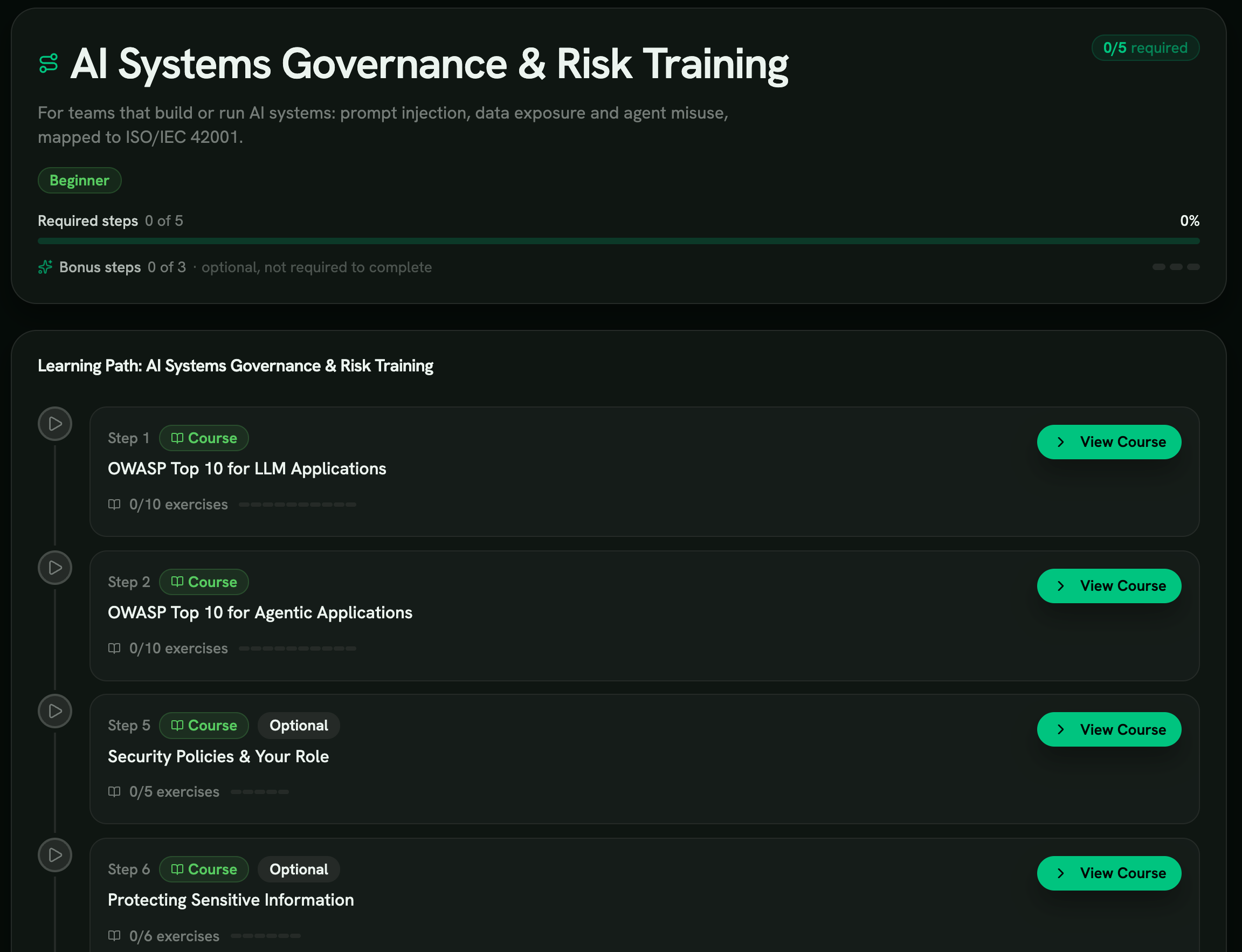
AI Systems Governance & Risk Training: eight courses and two hands-on exercises, assigned again every 12 months.
- Three OWASP courses
- LLM applications, agentic applications and MCP, for the teams that build and wire up AI.
- Two practice exercises
- A deepfake voice call drill and a generative AI data-handling task.
- Records per person
- PDF certificates, a tenant CSV, the compliance report page, and Vanta or Drata sync.
The competence loop an auditor walks through
Clause 7.2 follows the same steps in every ISO management system. The last two are where AI changes the content.
- 1 7.2 a Define the competence Decide what each role that affects AI performance needs to know.
- 2 7.2 b-c Close the gaps Train, mentor or reassign, then check that it worked.
- 3 7.2 d Keep the evidence Documented information an auditor can open and date.
- 4 7.3 Know the AI policy Everyone in scope knows the policy and their part in it.
- 5 Annex A Roles, people, impact Named AI roles, the human resources behind them, and impact assessment.
The path recurs every 12 months, so each surveillance audit finds a fresh record.
Where people appear in ISO/IEC 42001
Where people show up in the standard, clause by clause.
01 Clause 5: leadership and the AI policy
Top management sets the AI policy and assigns responsibilities for the AIMS.
That policy is what Clause 7.3 later expects every person in scope to know about. Training is how you show the policy reached people, not just the intranet.
02 Clause 6: AI risk and AI system impact assessment
Clause 6 asks for an AI risk assessment and an AI system impact assessment covering effects on individuals, groups and society.
The people running those assessments need to understand how AI systems fail. The OWASP courses give them a shared vocabulary for prompt injection, excessive agency and tool poisoning.
03 Clause 7.2: competence
You decide what competence each role needs, make sure people have it through education, training or experience, and check that the action worked.
You keep documented information as evidence. In practice the auditor samples a few people in AI roles and asks to see their records.
04 Clause 7.3: awareness
Everyone doing work under your control should know:
- that the AI policy exists
- how their work contributes to the AIMS
- what happens when they do not follow it
This reaches beyond engineers to anyone who uses AI tools at work.
05 Annex A: roles, resources and impact
Annex A is a normative list of reference controls, with implementation guidance in Annex B. Several of them depend on people.
- Roles and responsibilities for AI are defined and allocated.
- Human resources, including their competences, are documented as a resource for AI systems.
- AI system impact assessment is a defined process with named owners.
06 Clauses 9 and 10: audit and improvement
Internal audit and management review check whether the AIMS works. Nonconformities need corrective action.
A missing training record for someone in an AI role is a typical minor nonconformity. Recurring assignment stops the gap from opening again next year.
07 How the path fits an ISO 42001 programme
The AI Systems Governance & Risk Training path is aimed at teams that build or run AI systems. It has eight required items and three optional courses:
- AI Basics for Everyone and AI at Work for shared grounding.
- OWASP Top 10 for LLM Applications, OWASP Top 10 for Agentic Applications and OWASP MCP Top 10 for the build side.
- The deepfake audio detection drill and the safe generative AI exercise for practice.
- EU AI Act Compliance for the legal context.
- Optional: Security Policies & Your Role, Protecting Sensitive Information, Incident Reporting.
Clause 7.2 is role-based, so assign the path to the people your AIMS scope names. Staff who only use AI tools can take AI Basics for Everyone on its own for Clause 7.3 awareness.
The path is assigned again every 12 months. Each completion produces a per-user PDF certificate and a row in the tenant CSV export.
The compliance report page shows completion across the tenant, and Vanta or Drata sync sends the same records to your compliance platform.
Controls that rest on trained people
The AIMS controls that only work if the people behind them are trained.
AI roles and responsibilities
Annex A expects roles for AI to be defined and allocated. A role on an org chart is not competence.
The learning path gives each person in an AI role a dated record of the courses behind it, which is what links Annex A to Clause 7.2.
AI risk: LLM, agent and MCP threats
Risk owners cannot assess threats they have never seen. The three OWASP courses cover:
- the OWASP Top 10 for LLM Applications
- the OWASP Top 10 for Agentic Applications
- the OWASP MCP Top 10
Each module is built around a scenario, so engineers practise spotting the flaw instead of reading a list.
Impact assessment literacy
An AI system impact assessment asks how a system could affect people. AI Basics for Everyone and AI at Work give non-engineers enough grounding to take part in that discussion.
The EU AI Act Compliance course adds the legal side for teams whose systems reach the EU.
Data handling around AI tools
An AI policy usually says which tools are approved and what may go into them. In the Safe GenAI Usage exercise a deadline pushes the learner to paste a client email, account number and budget into a free consumer chatbot, and they practise choosing the approved tool and cleaning the prompt first.
Protecting Sensitive Information is available as an optional course for roles that handle personal or client data.
Synthetic media and social engineering
AI also changes the attacks your staff face. In the deepfake audio drill a caller who sounds like the CEO, with matching caller ID, wants a wire sent before the end of the day.
The learner applies a challenge phrase, a callback on a separate channel and the two-person rule before any money moves.
Incident reporting and the AI policy
Two optional courses support Clause 7.3 directly. Security Policies & Your Role covers what a policy asks of each person, and Incident Reporting covers what to report and how.
Make them required for roles where your AI policy says so.
Recommended exercises
Attack-side practice for engineers, everyday judgement for everyone who prompts.
What certification looks like in practice
No regulator and no fines. The pressure comes from auditors and customers.
AWS: accredited certification for four AI services
In November 2024 AWS announced ISO/IEC 42001 accredited certification for Amazon Bedrock, Amazon Q Business, Amazon Textract and Amazon Transcribe. The certifier was Schellman, accredited by ANAB.
AWS reported its first surveillance audit, completed in November 2025, closed with no findings. Certification is not a one-off: the auditor comes back.
Microsoft: Copilot products in scope
Microsoft lists Microsoft Copilot, GitHub Copilot, Copilot Studio, Security Copilot, Microsoft Foundry and others as in scope for its ISO/IEC 42001 certification.
Its compliance page makes a point worth repeating to your own team: customers can use the certificate in their assessment, but they still need an assessor to evaluate their own controls.
ISO/IEC 42006: rules for the auditors
ISO/IEC 42006, published in July 2025, sets extra requirements for bodies that audit and certify an AIMS against ISO/IEC 42001. It adds to ISO/IEC 17021-1.
For you this means auditors are themselves held to a competence standard, and they will expect the same discipline in your Clause 7 records.
Further reading
Related glossary terms
References
- ISO/IEC 42001:2023 Information technology: Artificial intelligence: Management system (preview) ISO/IEC, via VDE Verlag
- ISO/IEC 42001:2023 standard page International Organization for Standardization
- ISO/IEC 42006:2025 audit and certification of AI management systems International Organization for Standardization
- Standardisation of the AI Act European Commission, DG CNECT
- AWS achieves ISO/IEC 42001:2023 accredited certification Amazon Web Services
- AWS completed its first surveillance audit for ISO 42001:2023 with no findings Amazon Web Services
- ISO/IEC 42001:2023 offering Microsoft Learn
Give your AIMS auditor a training record that holds up
Role-specific AI courses, practice drills and dated evidence on a yearly cycle.
Frequently asked questions
What is ISO/IEC 42001 security awareness training?
Competence and awareness evidence for an AI management system, from prompt hygiene to OWASP risks in agents and MCP servers.
Does ISO/IEC 42001 require training?
Not by that word alone. Clause 7.2 requires you to determine the competence of people whose work affects AI performance and ensure they have it through education, training or experience. Clause 7.3 requires awareness of the AI policy.
For most organisations, training is the practical way to meet both, and the records are what an auditor checks.
Who needs ISO 42001 training?
Anyone in the scope of your AIMS whose work affects the AI systems: developers, data scientists, product owners, people who operate AI tools and the risk owners who assess them.
Everyone else in scope needs the lighter Clause 7.3 awareness: knowing the AI policy and their part in it.
Is ISO 42001 certification mandatory?
No. It is a voluntary standard. Organisations certify because customers ask for it in procurement or because it gives structure to AI governance they need anyway.
There are no fines. The consequence of weak training is an audit nonconformity that you must correct.
Does ISO 42001 certification mean we comply with the EU AI Act?
No. Under the AI Act, only harmonised standards referenced in the Official Journal give a presumption of conformity. ISO/IEC 42001 is not one of them.
The first harmonised standard for the Act, a quality management standard for high-risk AI providers, was referenced in October 2026. An AIMS still helps, because it gives you the risk, documentation and competence processes the Act also expects. See our EU AI Act page for the Article 4 literacy duty.
How does ISO 42001 relate to ISO 27001?
Both use the same harmonized structure, so Clauses 4 to 10 line up and you can run them as one integrated system. ISO 27001 covers information security. ISO 42001 covers how AI systems are developed, provided and used responsibly.
Training records can serve both if each course is mapped to the clauses it supports.
How often should ISO 42001 training happen?
The standard sets no frequency. You have to show that competence is current and that you evaluated whether training worked.
A yearly cycle lines up with surveillance audits, which is why the learning path recurs every 12 months.