
Best Secure Coding Training Platforms for 2026
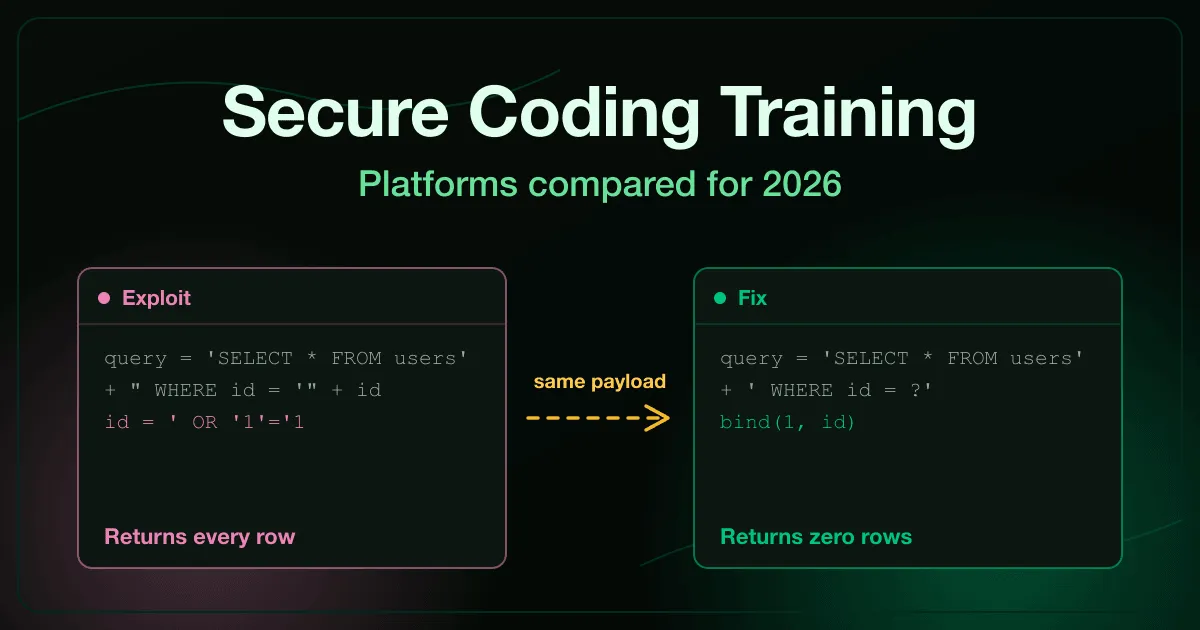
The best secure coding training platform in 2026 depends on how your developers learn and how wide your stack runs. Secure Code Warrior leads on language breadth and enterprise benchmarking. Veracode Security Labs fits teams already standardized on Veracode scanning. RansomLeak wins on exploit-then-fix depth across web, API, Git, cloud, mobile, and frontend. This roundup compares eight application security training vendors with a transparent methodology.
Updated August 2026.
What is secure coding training?
Section titled “What is secure coding training?”Secure coding training is developer-focused education that teaches engineers to find, exploit, and fix vulnerabilities in the code they write. It targets software engineers rather than the general workforce, uses their actual languages and frameworks, and measures skill through hands-on labs instead of quiz completion.
The category sits next to security awareness training but does not overlap with it. Awareness programs teach a finance clerk to question a wire transfer request. Secure coding programs teach a backend engineer why string concatenation in a query builder hands an attacker the whole table.
Buyers evaluate these platforms on four things. Whether the labs are genuinely hands-on or video with a quiz attached, how many languages and frameworks are covered, how the catalogue maps to the OWASP Top 10, and whether coverage extends past web applications into APIs, pipelines, and cloud configuration.
How we ranked these application security training vendors
Section titled “How we ranked these application security training vendors”Ranking one list across every buyer produces a misleading answer, so we applied four criteria and noted weaknesses next to strengths.
The first is practice depth. A platform where developers read an explanation and answer a question is a different product from one where they run the payload themselves and watch it work. We weighted the second heavily, because the fix a developer writes after breaking something tends to stick.
The second is stack coverage. Most catalogues are organized around web application flaws. Fewer cover the API layer properly, and fewer still reach version control, container and cloud configuration, mobile, or the browser.
The third is OWASP currency. OWASP Top 10:2025 was announced in November 2025 and finalized in January 2026, adding Software Supply Chain Failures as A03 and Mishandling of Exceptional Conditions as A10, and folding SSRF into Broken Access Control. The underlying vulnerability classes are stable, but catalogue mapping and reporting labels are not, so ask every vendor which edition they map to today.
The fourth is measurement. According to the Veracode State of Software Security 2025 report, half of organizations carry critical security debt and average time to fix flaws has risen 47% since 2020. A training platform that cannot show whether it moved those numbers is hard to renew.
1. RansomLeak
Section titled “1. RansomLeak”RansomLeak is an interactive security training platform whose application security catalogue puts developers on both sides of every vulnerability. You start as the attacker against a deliberately vulnerable app running in a simulated browser, then switch to the appsec engineer, ship the fix, and re-run the original payload against your own patch. The company comes from the team behind Kontra Application Security Training.
Coverage runs past the web Top 10. Alongside the API Security catalogue, the platform ships tracks for Git and version control, DevOps and cloud (Docker, Kubernetes, AWS, Azure, GCP), mobile, and frontend. Vulnerable code and its fix render in JavaScript, TypeScript, Java, C#, Python, Scala, PHP, Ruby, Go, and Kotlin.
The database in each exercise is real and embedded, so requests are visible in the browser Network panel rather than described in a slide. Try SQL injection, broken object level authorization, or server-side request forgery to see the format before talking to anyone.
Strengths: Exploit-then-fix on every exercise, breadth across web, API, Git, cloud, mobile, and frontend, ten-language code rendering, free browser-based catalogue with no sign-up, SCORM and LTI 1.3 delivery into an existing LMS.
Weaknesses: Newer platform than the decade-old incumbents, no IDE plugin, no static-analysis product to tie findings back to, smaller published customer roster.
Best for: Engineering organizations that want developers to break and repair real code, and that need coverage past web applications into pipelines and cloud.
Pricing note: Custom pricing for enterprise deployments. The full exercise catalogue is free to run without a sales call.
2. Secure Code Warrior
Section titled “2. Secure Code Warrior”Secure Code Warrior is the category’s largest independent vendor and the reference point most buyers start from. Vendor materials describe the Learning Platform as 600+ hours of content across 70+ language and framework combinations, with hands-on labs, learning paths, assessments, and gamified tournaments.
Its strongest differentiator is measurement. SCW Trust Score, launched in May 2024, benchmarks a team’s secure coding skill against a large cross-customer dataset, which gives security leaders a defensible number to bring to a board. In March 2026 the company shipped Trust Agent, which tracks which models influenced a commit and can block at pull-request time.
Strengths: Widest language and framework coverage in the category, cross-customer benchmarking, mature enterprise integrations, strong analyst visibility.
Weaknesses: No published pricing, third-party procurement writeups put enterprise contracts well into six figures, some reviewers describe the shorter challenge format as repetitive at scale.
Best for: Large engineering organizations with a polyglot codebase that need benchmarking and program-level reporting.
Pricing note: Custom, priced per developer seat. Not published.
3. Security Journey
Section titled “3. Security Journey”Security Journey is the combined product of HackEDU and Security Journey, which merged after HackEDU’s acquisition in May 2022 and consolidated under the Security Journey name that August. The platform is organized as a belt program, running from foundational white belt content up through language-specific hands-on work.
The belt structure is the real draw. It gives program owners a defensible progression to assign by role and seniority, which matters more than raw lab count when you are rolling training across hundreds of engineers with different starting points. Content mixes video lessons with hands-on coding exercises.
Strengths: Progressive belt curriculum that is easy to map to role and seniority, broad language coverage, blended video and hands-on formats, covers non-developer SDLC roles.
Weaknesses: Video-heavy relative to lab-first platforms, brand recognition still split across two legacy names, lighter coverage of cloud and pipeline topics.
Best for: Programs that need a structured, auditable progression across a large and mixed engineering population.
Pricing note: Custom, per-seat.
4. Veracode Security Labs
Section titled “4. Veracode Security Labs”Veracode Security Labs teaches through containerized environments where developers connect to a live terminal, exploit a running vulnerable application, and patch it. The technical depth is genuine, and the labs feel closer to real work than most competitors’ browser challenges.
The platform’s gravity comes from the rest of Veracode. If your SAST and SCA findings already land there, routing a developer from a specific finding into a lab about that flaw class is a short path. Standalone, the training is harder to justify against dedicated vendors, though a free Community Edition exists for individual developers.
Strengths: Real containerized environments, tight loop between scan findings and remediation training, free Community Edition, established enterprise procurement path.
Weaknesses: Most valuable to existing Veracode customers, narrower catalogue than dedicated training vendors, lighter gamification and engagement tooling.
Best for: Teams already running Veracode who want remediation training attached to their scan results.
Pricing note: Custom, commonly bundled with the wider Veracode platform.
5. Security Compass
Section titled “5. Security Compass”Security Compass sells application security training alongside SD Elements, its policy-to-requirements platform. The company acquired Kontra from ThriveDX in February 2024, adding Kontra’s interactive developer exercises to a portfolio that already included a 50+ course AppSec curriculum and ISC2 co-branded practitioner suites.
The distinctive capability is just-in-time training inside SD Elements. Countermeasures generated for a specific project carry associated micro-modules, so a developer gets the relevant lesson attached to the requirement rather than at annual training time. Courses are mapped to NIST 800-53, PCI DSS, ISO/IEC 27034, HIPAA, and SOC 2.
Strengths: Just-in-time delivery tied to project requirements, deep compliance mapping, Kontra’s interactive exercises, formal certification paths.
Weaknesses: Training is strongest when paired with SD Elements, the combined portfolio spans several acquired products with differing interaction models, heavier implementation effort.
Best for: Regulated enterprises that want secure coding training wired into a requirements and compliance workflow.
Pricing note: Custom, typically quoted with SD Elements.
6. SecureFlag
Section titled “6. SecureFlag”SecureFlag runs training in real development environments, giving developers a working IDE and a live application rather than a simulated editor. Its catalogue covers a large library of hands-on labs across 45+ technology stacks, spanning application code, infrastructure as code, and container configuration.
The infrastructure and container coverage is the reason to shortlist it. Teams whose risk sits in Terraform and Kubernetes manifests as much as in application code find more relevant material here than in web-first catalogues.
Strengths: Real IDE and runtime environments, strong infrastructure-as-code and container coverage, broad technology stack list, threat-modelling content.
Weaknesses: Smaller company and support footprint, less brand recognition in enterprise procurement, environment spin-up adds friction for short sessions.
Best for: Platform and DevOps-heavy engineering teams that want labs in the tools they actually use.
Pricing note: Custom, per-seat.
7. Snyk Learn
Section titled “7. Snyk Learn”Snyk Learn is free developer security education from Snyk, covering vulnerability classes across JavaScript, Java, C#, Python, PHP, Go, Rust, Ruby, and C++, plus Kubernetes, AI, and LLM topics. Lessons walk through how a vulnerability works, show it in code, and explain the fix.
It is the best free starting point in this list and a reasonable supplement to a paid program. It is not an enterprise training program. There is no seat management, no role-based assignment, and no compliance reporting, so it cannot carry an audit requirement on its own.
Strengths: Genuinely free, good language spread, clear writing, no procurement cycle, useful AI and LLM security lessons.
Weaknesses: No administration or assignment layer, no compliance evidence, lessons are explanatory rather than adversarial, functions partly as a funnel into Snyk’s scanning products.
Best for: Individual developers, small teams, and organizations that want a free baseline before buying.
Pricing note: Free.
8. Avatao
Section titled “8. Avatao”Avatao is a European secure coding platform aimed at small and mid-sized engineering teams, with hands-on labs mapped to ISO 27001, PCI DSS, SOC 2, and NIS2. The compliance mapping is the pitch, and it is a real one for teams whose training budget exists because an auditor asked for evidence.
Avatao is a fit where the buying trigger is a certification rather than a vulnerability trend. Catalogue breadth is smaller than the category leaders, and enterprise reporting is lighter.
Strengths: Compliance-mapped content, EU-based, sized and priced for smaller engineering teams, straightforward rollout.
Weaknesses: Smaller catalogue than category leaders, lighter analytics, limited coverage outside core application security.
Best for: SMB and mid-market engineering teams driven by an ISO 27001, SOC 2, or NIS2 requirement.
Pricing note: Custom, positioned below enterprise vendors.
What should application security training cover in 2026?
Section titled “What should application security training cover in 2026?”Web application flaws are the floor, not the ceiling. A catalogue that stops at the classic web Top 10 leaves most of a modern attack surface untouched.
APIs deserve their own track. Broken object level authorization and mass assignment do not behave like web vulnerabilities, they are rarely visible in a rendered page, and they are the flaws that most often leak records at scale. Ask whether the vendor treats the OWASP API Security Top 10 as a real course or a handful of bolt-on lessons.
Version control and pipelines are now first-class. Secrets committed to Git, over-permissive workflow tokens, and poisoned build steps sit behind a large share of recent incidents, and OWASP’s 2025 refresh promoted supply chain failures to A03 for exactly that reason.
Cloud and container configuration belongs in the same program. A misconfigured storage bucket, an over-broad IAM role, or a privileged Kubernetes pod is a production vulnerability written by an engineer, and it should be trained like one.
Mobile and frontend round out the set. Insecure local storage, weak certificate handling, and stored cross-site scripting live outside the server-side catalogue that most vendors organize around.
AI-assisted development changes the load. Assistants generate insecure patterns at speed, which raises the value of a developer who recognizes them on review. See AI coding assistant security risks and the OWASP LLM Top 10 training course for that side of the program.
How is secure coding training different from security awareness training?
Section titled “How is secure coding training different from security awareness training?”They target different people, teach different skills, and answer to different controls. Security awareness training covers the whole workforce on phishing, social engineering, and data handling. Secure coding training covers engineers on the vulnerability classes they can introduce in code.
Most compliance frameworks want both. SOC 2, ISO 27001, and PCI DSS ask for workforce awareness and for role-specific training for people who build and maintain systems, which is why programs that run only one of the two get findings.
Buying them from one vendor is not required, but it simplifies evidence collection. If you are also evaluating the awareness side, see best security awareness training for 2026.
Which secure coding training platform fits your team?
Section titled “Which secure coding training platform fits your team?”Use this to narrow the shortlist quickly.
Large polyglot engineering orgs (500+ developers). Start with Secure Code Warrior for language breadth and benchmarking. Add RansomLeak if you want exploit-then-fix depth and coverage past web into Git, cloud, mobile, and frontend. Add Security Journey if a defensible role-based progression matters more than lab realism.
Mid-market product teams (50 to 500 developers). RansomLeak, Security Journey, and SecureFlag are the strongest fits. Pick RansomLeak for attacker-and-defender practice across the full stack. Pick SecureFlag if most of your risk is in Terraform, containers, and Kubernetes.
Small teams and startups (under 50 developers). Start with Snyk Learn for free, then add a paid platform when an audit or a customer questionnaire forces the issue. Avatao is priced for this segment when the trigger is ISO 27001 or SOC 2.
Existing Veracode or Snyk customers. Check the bundled training first. Routing developers from a real finding into a lab about that flaw class is worth more than a marginally better standalone catalogue.
Regulated enterprises with formal SDLC requirements. Security Compass is built for this, particularly where SD Elements already generates project countermeasures. Confirm which OWASP edition each vendor’s compliance mapping reflects before signing.
LMS-first organizations. If training has to run inside Cornerstone, Workday, or Moodle rather than a new console, confirm SCORM or LTI delivery early. Several appsec vendors are console-only. See SCORM security training for how that constraint plays out.
Frequently asked questions
Section titled “Frequently asked questions”What is the best secure coding training platform in 2026?
Section titled “What is the best secure coding training platform in 2026?”There is no single best platform. Secure Code Warrior leads on language breadth and benchmarking for large polyglot organizations, and Snyk Learn is the best free option. RansomLeak is the strongest fit for teams that want developers to exploit a flaw before fixing it, with coverage across web, API, Git, cloud, mobile, and frontend.
How much does secure coding training cost?
Section titled “How much does secure coding training cost?”Almost no vendor in this category publishes pricing. Contracts are quoted per developer seat on an annual term, and third-party procurement writeups place enterprise agreements with the largest vendors in the six-figure range. The more useful frame is cost per measurable reduction in recurring flaw classes, not cost per seat.
Does secure coding training actually reduce vulnerabilities?
Section titled “Does secure coding training actually reduce vulnerabilities?”It depends entirely on format. Training that asks developers to recognize a vulnerability produces recall. Training that asks them to cause one, then patch it, and then replay the original payload against the patch produces a repeatable skill. The Veracode State of Software Security 2025 report found average time to fix flaws has risen 47% since 2020, which suggests recognition-only programs are not moving the number.
How often should developers do secure coding training?
Section titled “How often should developers do secure coding training?”Continuously in small increments rather than annually in a block. The pattern that works is a short module tied to a real event, a finding in a pull request, a new service going live, or an onboarding week, reinforced with a few hands-on exercises per quarter. Annual compliance blocks satisfy an auditor and change very little behavior.
Should secure coding training map to OWASP Top 10 2021 or 2025?
Section titled “Should secure coding training map to OWASP Top 10 2021 or 2025?”Map your program to 2025 and expect vendor catalogues to lag. The 2025 edition added Software Supply Chain Failures at A03 and Mishandling of Exceptional Conditions at A10, and folded SSRF into Broken Access Control. The vulnerability classes themselves did not change, so exercises on SSRF or XXE remain valid regardless of which category label a vendor files them under.
Can secure coding training run inside our existing LMS?
Section titled “Can secure coding training run inside our existing LMS?”Sometimes. Console-first vendors expect developers to log into their platform, which is a real adoption obstacle when every other training already lives in the corporate LMS. RansomLeak delivers through SCORM 1.2, SCORM 2004, and LTI 1.3 with completion passback. Confirm this in the demo rather than the datasheet.
Do we still need security awareness training if developers get secure coding training?
Section titled “Do we still need security awareness training if developers get secure coding training?”Yes. They cover different populations and different controls, and engineers get phished like everyone else. Most frameworks expect a general awareness program plus role-specific depth for technical staff. Run both and map each to the control it satisfies.
Bottom line
Section titled “Bottom line”The secure coding training market splits three ways in 2026. Breadth-and-benchmarking vendors (Secure Code Warrior, Security Journey) compete on catalogue size and program reporting, while ecosystem vendors (Veracode, Snyk, Security Compass) compete on proximity to the tools that already produce your findings. Practice-depth vendors (RansomLeak, SecureFlag) compete on how real the lab feels.
The question that separates them is simple. Does a developer leave the exercise having recognized a vulnerability, or having caused one and repaired it.
Run one and find out. Break a login form with SQL injection, walk an API’s object IDs with broken object level authorization, or plant a payload with stored cross-site scripting, then ship the fix and replay your own attack against it. Browse the application security and API security catalogues, or talk to us about rolling it out across an engineering org.
No sign-up, no sales pitch. Every exercise runs in the browser against a real embedded database, with the vulnerable code and its fix in ten languages. See platform features for SSO, reporting, and LMS delivery.