
Cybersecurity Awareness Month 2026: Themes and Dates
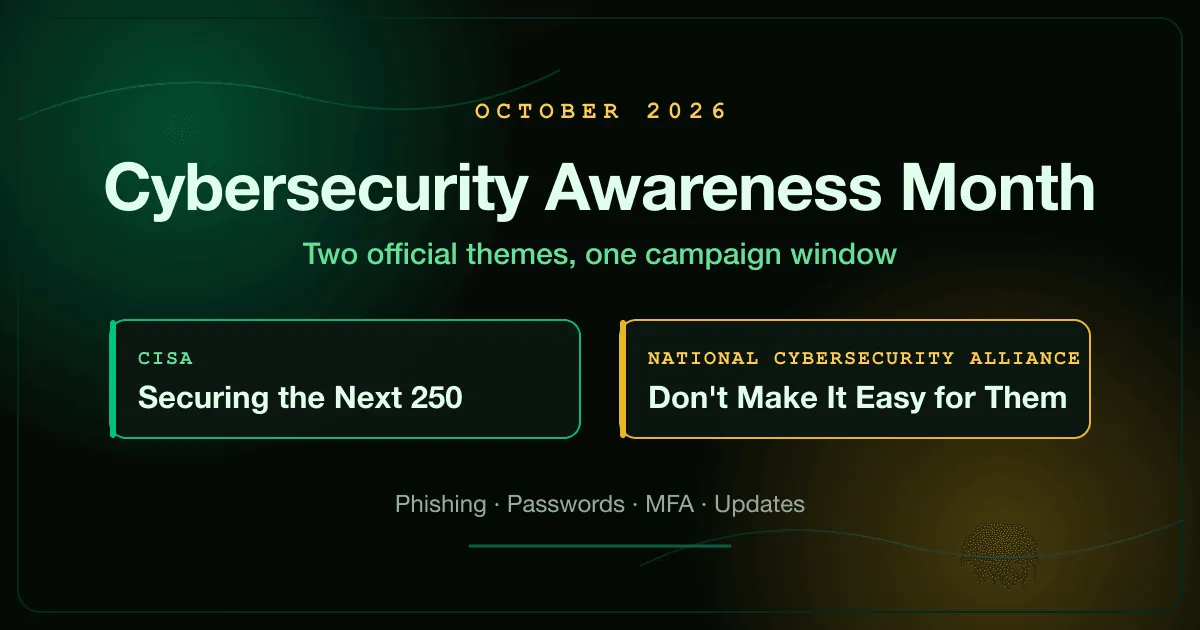
If you are planning October and looking for “the” 2026 theme, you will find two of them. That is not a mistake in someone’s blog post. The two organizations that co-founded the campaign published different wording this year, and knowing which is which saves you an awkward correction in front of your exec sponsor.
What is Cybersecurity Awareness Month?
Section titled “What is Cybersecurity Awareness Month?”Cybersecurity Awareness Month is an annual campaign held every October since 2004, run jointly by the US Cybersecurity and Infrastructure Security Agency and the National Cybersecurity Alliance. It gives organizations a fixed calendar window to train staff on phishing, passwords, multifactor authentication, and software updates, backed by free public toolkits.
The month has no legal force. Nobody audits you for participating, and no regulation requires it.
What it does give you is a reason. Budget conversations that stall in March suddenly move in October, because the campaign turns a security ask into a calendar event that the rest of the business already recognizes.
When is Cybersecurity Awareness Month 2026?
Section titled “When is Cybersecurity Awareness Month 2026?”October 1 to October 31, 2026. The month opens on a Thursday and closes on a Saturday.
That shape matters more than it sounds. You get four clean working weeks plus a stray Thursday and Friday at the start, which is why most workable plans run four themed weeks and treat October 1 and 2 as the launch.
If you want the day-level version, we mapped one in our 31-day October activity plan.
What is the 2026 Cybersecurity Awareness Month theme?
Section titled “What is the 2026 Cybersecurity Awareness Month theme?”There are two, and they come from the two co-founders of the campaign.
CISA is running “Securing the Next 250”, tied to the United States turning 250 and aimed squarely at the operators who keep power, water, and other critical services running. The National Cybersecurity Alliance is running “Don’t Make It Easy for Them”, which argues that safety online comes from habits repeated in small everyday moments rather than one perfect decision.
Pick the one that fits your audience. Critical infrastructure and public sector teams will get more mileage from the CISA framing. Everyone else, especially a general office population, will find the Alliance framing easier to say out loud without sounding like a press release.
You can also run both. The Alliance wording works as the internal campaign slogan while the CISA material carries your technical and operational track.
What does CISA want organizations to do in 2026?
Section titled “What does CISA want organizations to do in 2026?”CISA still leads with four actions for individuals, and they have barely changed in three years:
- Avoid and report phishing scams
- Use strong passwords
- Use multifactor authentication and a password manager
- Update software
For organizations, CISA adds logging, data backups, encryption, reporting incidents to CISA, and having an incident response plan you have actually tested.
The newer piece is aimed at critical infrastructure operators. CISA calls it the 3Rs: Reduce, Replace, Recover. Reduce your exposed vulnerabilities, replace devices that are past end of support, and be able to recover fast enough to keep operating.
If you run OT, medical devices, or building systems, the 3Rs are the part of the 2026 material worth bringing to your leadership rather than your all-hands.
What should you actually train on this October?
Section titled “What should you actually train on this October?”The four CISA actions map cleanly onto practice, and practice is the part most October campaigns skip. A poster tells someone MFA exists. It does not teach them what to do when six push prompts arrive at 2am from a login they did not start.
Here is how we would wire the four actions to something people do rather than read:
- Phishing. Run a simulation, then make reporting the measured behavior instead of clicking. Reporting Culture is built around the moment someone decides whether it is worth telling anyone.
- MFA. Push fatigue is the attack that beats MFA rollouts, and it does not look like an attack. MFA Fatigue Attack puts the learner on the receiving end of the prompt storm.
- Updates. Most people postpone the restart because they do not know what the update was for. OS Updates & Patching Basics connects the deferred reboot to what it leaves open.
- Recovery. The R in the 3Rs that employees can affect is whether their work is actually backed up. Backup Best Practices covers what a backup needs to survive ransomware, not just a dead laptop.
All four are free to run and need no sign-up. The rest of the free set lives in the security awareness catalogue.
What do the official themes leave out?
Section titled “What do the official themes leave out?”AI. Neither 2026 theme names it, and both are right not to, because CISA and the Alliance write for the whole country and the basics still stop most attacks.
Your employees do not live in the whole country. They live in an inbox where phishing is now written by a model, and answer calls where the voice on the line was cloned from a conference talk. The tells that awareness training taught for a decade, bad grammar and odd formatting, stopped being reliable somewhere around 2024.
If your population is knowledge workers, add a fifth track on synthetic media and AI-assisted social engineering. We broke down the current attack patterns in deepfake social engineering, and the hands-on versions sit in the AI security catalogue, starting with AI-Written Phishing and Cloned Voice Payment Fraud.
Where do you get free Cybersecurity Awareness Month resources?
Section titled “Where do you get free Cybersecurity Awareness Month resources?”Three places, none of which cost anything.
CISA publishes a Cybersecurity Awareness Month toolkit with messaging and graphics on its site. The National Cybersecurity Alliance gives registered Champions a toolkit that includes a scam tipsheet, eight printable posters, and 32 social media graphics in static and video formats, plus access to speakers and their annual research report on public cybersecurity behavior.
Registering as a Champion is free and takes a few minutes. It is the cheapest way to get an October campaign that looks designed rather than assembled the night before.
For the training itself, our full catalogue of interactive exercises is free to run with no account. If you would rather not build the schedule yourself, the security awareness training guide covers program structure beyond a single month.
How do you stop October from being the only month that matters?
Section titled “How do you stop October from being the only month that matters?”This is the honest failure mode. Click rates dip in October, everyone congratulates each other, and by February the numbers are back where they started.
Two things fix it, and neither is a bigger October. First, measure reporting rate rather than click rate, because reporting is the behavior you actually want and it keeps improving after the campaign ends. Second, decide in October what runs in November, and put it in the calendar before the month closes.
Treat the campaign as the launch of a twelve-month program that happens to have a loud first month. The alternative is an annual event that your employees learn to wait out.
Start planning October now
Section titled “Start planning October now”Twenty days is enough time to run a good campaign and not enough to invent one from scratch. Take the four CISA actions, add an AI track if your people work in an inbox, and schedule one thing per week rather than one big thing.
The 31-day October plan has the week-by-week version with specific exercises attached to specific days.
If you want help building an October program that survives into next year, talk to us. We will tell you honestly whether you need a platform or just a better calendar.