
EU AI Act Timeline: Compliance Deadlines to 2028
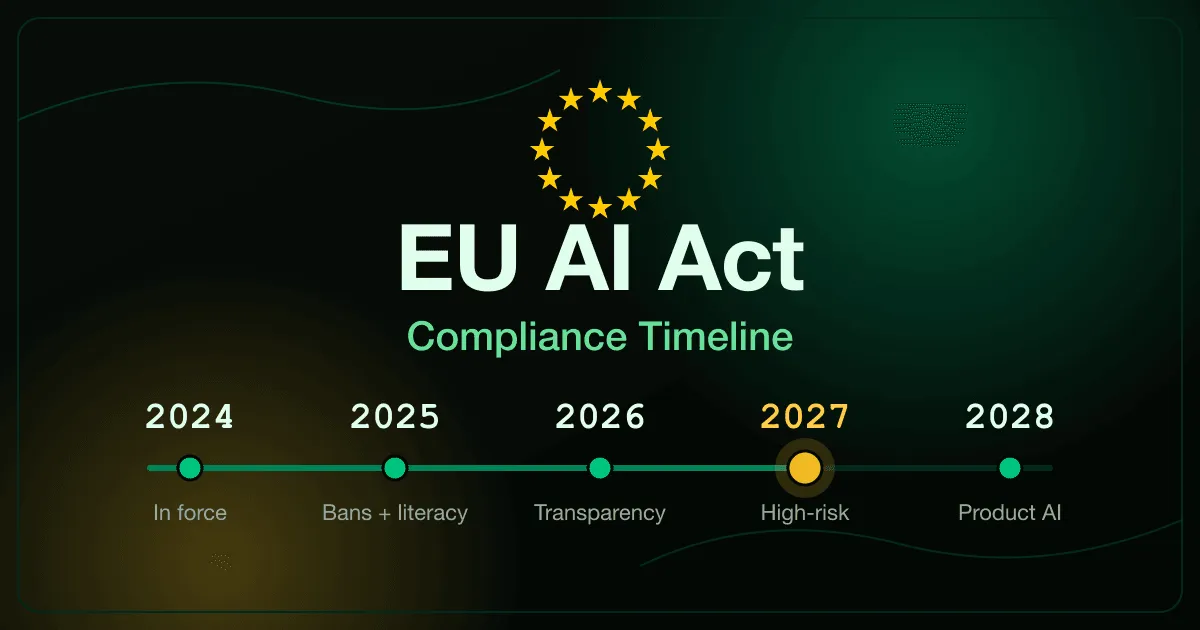
The EU AI Act does not arrive on a single date. It applies in stages between 2024 and 2028, and each stage switches on a different set of obligations for the organizations that build or use AI systems in Europe.
The schedule also moved. The Digital Omnibus on AI, in force since 27 July 2026, pushed the high-risk regime for Annex III systems back to 2 December 2027, which gives most compliance teams extra runway while the obligations themselves still arrive.
What is the EU AI Act timeline?
Section titled “What is the EU AI Act timeline?”The EU AI Act timeline is the staged schedule that brings Regulation (EU) 2024/1689 into force between 2024 and 2028. The law entered into force on 1 August 2024. Prohibited practices and AI literacy duties applied on 2 February 2025, the general-purpose AI rules on 2 August 2025, transparency duties on 2 August 2026, and the high-risk obligations apply from 2 December 2027.
The dates are set in the regulation and its 2026 amendment, so they apply uniformly across all 27 Member States. The table below is the fastest way to see which obligation switches on when.
| Date | What applies | Who it reaches | Top penalty tier |
|---|---|---|---|
| 1 Aug 2024 | Regulation enters into force | Everyone in scope | Not yet enforceable |
| 2 Feb 2025 | Prohibited practices (Article 5) and AI literacy (Article 4) | Every provider and deployer | €35M or 7% turnover |
| 2 Aug 2025 | General-purpose AI model rules, governance, and penalties (Article 99) | GPAI providers, authorities | €15M or 3% turnover |
| 27 Jul 2026 | Digital Omnibus in force: Article 4 reworded, high-risk dates moved | Everyone in scope | No change to tiers |
| 2 Aug 2026 | Transparency duties (Article 50) and the general date of application | Providers and deployers of chatbots and synthetic content | €15M or 3% turnover |
| 2 Dec 2026 | Two new Article 5 bans; marking deadline for synthetic-content systems already on the market | Providers and deployers of generative AI | €35M or 7% turnover |
| 2 Dec 2027 | High-risk obligations for Annex III systems | High-risk providers and deployers | €15M or 3% turnover |
| 2 Aug 2028 | High-risk systems embedded in regulated products (Annex I) | Product manufacturers | €15M or 3% turnover |
When did the EU AI Act enter into force?
Section titled “When did the EU AI Act enter into force?”The Artificial Intelligence Act, formally Regulation (EU) 2024/1689, entered into force on 1 August 2024. It is the first horizontal AI law in the world, and it governs providers, deployers, importers, and distributors of AI systems used inside the European Union.
Entry into force did not mean immediate enforcement. The regulation set a staged calendar so organizations and national authorities had time to build the supervisory architecture and adapt their systems.
The reach extends past EU borders. The Act applies when the output of an AI system is used in the Union, which pulls a large share of the global AI market into scope even for companies headquartered elsewhere.
What applied on 2 February 2025?
Section titled “What applied on 2 February 2025?”Two obligations switched on first, and both carry weight. The Article 5 ban on prohibited AI practices and the Article 4 AI literacy duty became enforceable on 2 February 2025.
The prohibited list covers eight categories, including social scoring, untargeted facial-image scraping, manipulative or exploitative systems, and emotion recognition in workplaces and schools. These cannot be placed on the EU market at all, and breaching the ban carries the highest penalty tier of €35 million or 7% of global annual turnover. Product, procurement, and legal teams need to recognize a prohibited use before it ships, which is the focus of the prohibited AI practices exercise.
Article 4 is the broadest obligation in the whole regulation, because it applies regardless of the risk tier of the systems involved. It originally required providers and deployers to ensure a sufficient level of AI literacy, and since 27 July 2026 it requires them to take measures to support the development of AI literacy of their staff.
The AI literacy essentials exercise trains the three behaviors the article actually expects: critical evaluation of AI output, verification before action, and disciplined data handling. For the full Article 4 breakdown, see our EU AI Act training guide.
What changed on 2 August 2025?
Section titled “What changed on 2 August 2025?”The second stage added the rules for general-purpose AI and the enforcement machinery behind the whole regulation. On 2 August 2025, the GPAI model obligations, the governance chapter, and the Article 99 penalty regime became applicable.
General-purpose AI providers now carry documentation, transparency, and copyright duties, with extra obligations for models that pose systemic risk. Deployers who build on top of these models inherit downstream responsibilities, a split that the general-purpose AI model obligations exercise maps out role by role.
The same date stood up the EU AI Office inside the European Commission and required Member States to name national competent authorities. The EU AI Act penalties and enforcement exercise walks through the three-tier fine structure so teams understand which obligations sit behind which financial exposure. The when AI use goes wrong exercise shows the same tiers from an employee’s desk, where the company pays the fine and the person answers to their employer.
What changed with the Digital Omnibus in 2026?
Section titled “What changed with the Digital Omnibus in 2026?”The Digital Omnibus on AI, Regulation (EU) 2026/1744, entered into force on 27 July 2026. It amended the Act days before the high-risk regime was due to start.
Three changes matter most for workforce planning. The high-risk dates moved, Article 4 now asks for measures that support AI literacy rather than a sufficient level of it, and two practices join the Article 5 ban from 2 December 2026: AI that generates non-consensual intimate imagery and AI that generates child sexual abuse material.
Not everything moved. The Article 50 transparency duties applied as planned on 2 August 2026, although providers of synthetic-content systems already on the market have until 2 December 2026 to add machine-readable marking.
What applies on 2 December 2027?
Section titled “What applies on 2 December 2027?”This is the heaviest deadline still ahead. From 2 December 2027, the high-risk obligations apply for the AI systems listed in Annex III.
Annex III covers eight domains where AI is high-risk by default: biometrics, critical infrastructure, education, employment, essential public and private services, law enforcement, migration and border control, and the administration of justice. Providers and deployers of these systems face the deepest controls in the Act, from risk management and data governance to human oversight and post-market monitoring. The high-risk AI deployer obligations exercise tests whether a launch is ready across the seven areas an auditor will check first.
Most enterprises are deployers of several high-risk systems and providers of a few. A bank running a credit-scoring model, a hospital using a triage tool, and a recruiter screening CVs with an AI shortlister all sit inside Annex III, so the December 2027 date is not a niche concern.
What is left for 2 August 2028?
Section titled “What is left for 2 August 2028?”One category extends further. High-risk AI systems that are embedded as safety components in products already regulated under EU law, listed in Annex I, have until 2 August 2028 to comply.
Annex I covers products such as machinery, medical devices, toys, and vehicles, where existing product-safety law already requires conformity assessment. The later date recognizes that AI obligations have to be folded into established certification processes rather than bolted on.
If your AI is a feature inside a regulated physical product, 2028 is your date. For everything in Annex III, the operative deadline is 2 December 2027.
Does the EU AI Act apply to companies outside the EU?
Section titled “Does the EU AI Act apply to companies outside the EU?”Yes, in many cases. The Act reaches providers and deployers established outside the EU when they place AI systems on the EU market or when the output produced by the system is used in the Union.
A US software vendor selling an AI hiring tool to European customers is a provider in scope. A company headquartered outside Europe whose AI generates results consumed by an EU branch can be a deployer in scope. The territorial reach mirrors the extraterritorial logic that made GDPR a global standard.
Non-EU organizations in scope generally need an authorized representative established in the Union. The practical takeaway is simple: location does not exempt you if your AI touches the European market.
How to prepare for each EU AI Act deadline
Section titled “How to prepare for each EU AI Act deadline”There is no single curriculum the Commission endorses, but the steps below match what national authorities and audit firms look for in a defensible program. Each one produces documentation that feeds the deadlines still ahead.
Step 1: Build an AI system inventory. List every AI system your organization builds or uses, who owns it, and what data it touches. The AI governance exercise shows how to build the registry and shut down shadow AI before it reaches a regulator’s attention.
Step 2: Classify each system by risk tier. Sort every entry in the inventory into prohibited, high-risk, limited-risk, or minimal-risk. The tier decides which obligations apply, and our EU AI Act risk categories guide explains how to make each call.
Step 3: Run AI literacy training across the workforce. Article 4 applies now, so this is the cheapest first step toward overall readiness. Train general staff on safe daily use and give technical and oversight roles deeper modules.
Step 4: Assign human oversight and incident handling. Name the people responsible for overseeing high-risk systems and define how staff report AI failures. The AI incident reporting exercise and responsible AI use exercise rehearse both routines.
Step 5: Document everything. Keep records of who trained on what, when systems were classified, and which oversight measures are in place. Authorities sample records, so the documentation is the compliance evidence.
How the EU AI Act fits with NIS2 and GDPR
Section titled “How the EU AI Act fits with NIS2 and GDPR”The AI Act rarely arrives alone. EU organizations usually have to align it with GDPR, NIS2, and other frameworks at the same time, and the training content overlaps more than most teams expect.
| Framework | Training-relevant obligation | Overlap with the AI Act |
|---|---|---|
| GDPR (EU 2016/679) | Lawful processing, data subject rights, breach response | Data governance, AI systems that process personal data |
| NIS2 (EU 2022/2555) | Cyber risk management, incident reporting, management training | Incident handling, governance, supply chain |
| EU AI Act (EU 2024/1689) | AI literacy, risk classification, human oversight | The core obligation set |
A GDPR employee training program already covers data handling that high-risk AI systems depend on. A NIS2 training program covers incident reporting routines the AI Act reuses. Organizations that build one awareness program mapped across frameworks spend far less than those running parallel trainings, a pattern we cover in our compliance training guide.
How RansomLeak supports EU AI Act readiness
Section titled “How RansomLeak supports EU AI Act readiness”RansomLeak training is interactive, scenario-based, and documented in a way supervisors recognize. The dedicated EU AI Act course covers the regulation, the staged timeline, the four risk tiers, and the day-to-day practices Article 4 expects, and every module exports as SCORM for the LMS an authority will inspect.
The privacy and compliance catalogue carries the full EU AI Act course alongside GDPR scenarios. The AI security catalogue covers prompt injection, deepfakes, and LLM manipulation that the shadow AI problem brings into scope. Role-based tracks produce the calibrated, documented literacy measures Article 4 asks for.
If you want to see how scenario-based training maps to each AI Act deadline, book a walkthrough with our team.
Frequently asked questions
Section titled “Frequently asked questions”When does the EU AI Act fully apply?
Section titled “When does the EU AI Act fully apply?”The regulation entered into force on 1 August 2024 and applies in stages. Prohibited practices and AI literacy applied on 2 February 2025, general-purpose AI rules on 2 August 2025, and transparency duties on 2 August 2026. After the 2026 Digital Omnibus, high-risk obligations for Annex III systems apply from 2 December 2027, and high-risk systems in regulated products under Annex I from 2 August 2028, the final date.
What is the most urgent EU AI Act deadline right now?
Section titled “What is the most urgent EU AI Act deadline right now?”For providers of generative AI it is 2 December 2026, when two new Article 5 bans apply and the marking grace period ends for synthetic-content systems already on the market. For most other organizations it is 2 December 2027, when high-risk obligations for Annex III systems reach banks, hospitals, recruiters, and public-service operators using AI in those domains. The Article 4 AI literacy duty already applies, so literacy work should be under way now.
What are the penalties for missing an EU AI Act deadline?
Section titled “What are the penalties for missing an EU AI Act deadline?”Article 99 sets three tiers. Prohibited-practice breaches reach up to €35 million or 7% of global annual turnover. Most operator obligations, including provider, deployer, and transparency duties, reach up to €15 million or 3%. Supplying incorrect, incomplete, or misleading information to authorities reaches up to €7.5 million or 1%. Small and medium enterprises, and since the 2026 Digital Omnibus small mid-cap companies too, face the lower of the two values rather than the higher.
Does the EU AI Act apply to small businesses?
Section titled “Does the EU AI Act apply to small businesses?”Yes. The obligations apply based on the role you play and the risk tier of your AI systems, not your company size. Small and medium enterprises and start-ups do get proportionate treatment, including the lower end of the penalty ranges and simplified technical documentation, but the AI literacy duty under Article 4 applies regardless of headcount.
How is the EU AI Act enforced?
Section titled “How is the EU AI Act enforced?”Enforcement runs through national competent authorities in each Member State and the EU AI Office inside the European Commission. The AI Office supervises general-purpose AI directly and coordinates the European Artificial Intelligence Board. National authorities handle market surveillance, can request documentation, and can impose the Article 99 fines.
What should we do first to prepare?
Section titled “What should we do first to prepare?”Build an inventory of every AI system you use or build, classify each one by risk tier, and start AI literacy training across the workforce. The literacy duty applies now and produces documentation that feeds the deeper obligations arriving in 2027 and 2028. Our EU AI Act risk categories guide explains how to classify each system.
Bottom line
Section titled “Bottom line”The EU AI Act is a staged regulation, and treating it as a single future deadline is the fastest way to fall behind. Four stages are already live, the high-risk regime arrives on 2 December 2027, and the final product-embedded systems follow in August 2028.
The work that satisfies the early stages also builds the evidence for the later ones. Start with an AI inventory, classify by risk, train the workforce on AI literacy, and document every step.
If your organization operates AI in Europe and wants scenario-based training mapped to each deadline, explore the privacy and compliance catalogue or talk to our team.