Skip to content

Blog

Open Source LMS for SCORM Training

Open source LMS platforms for security awareness training comparison

Open source sounds appealing. No licensing fees. Full control. Customization freedom.

But “free” software isn’t free. Before committing your security awareness training to an open source LMS, you need to understand what you’re actually signing up for. This guide covers the real tradeoffs, platform-by-platform comparisons, and the math that determines whether open source makes sense for your organization.

12 Cybersecurity Training Exercises

Cybersecurity awareness exercises - target with cursor representing interactive practice

Security awareness exercises that actually work share one thing: they create practice, not just knowledge.

The gap between knowing phishing exists and recognizing it in your inbox under deadline pressure is enormous. That gap is where breaches happen. Effective exercises bridge it through realistic practice in safe environments.

Compliance Training That Passes Audits

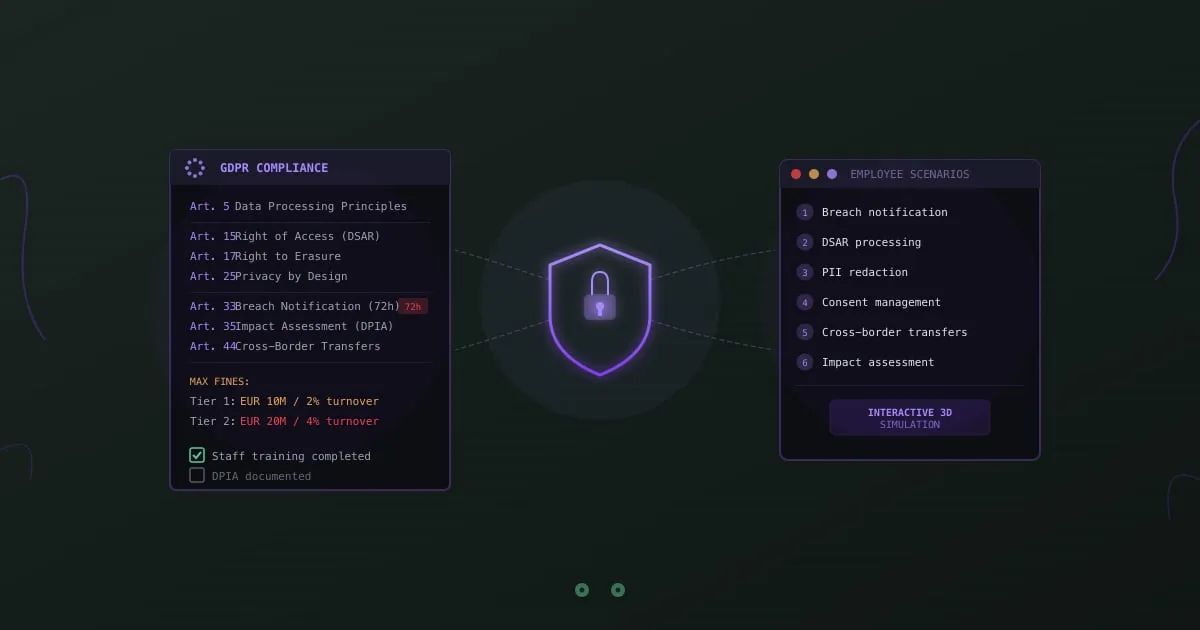
Compliance training - security shield with checkmarks representing regulatory compliance

Regulatory compliance is not optional. If you handle healthcare data, process payments, or serve European customers, specific frameworks mandate how you protect information. Security awareness training sits at the center of nearly every one of those requirements.

And yet most organizations treat compliance training as a checkbox exercise. Annual videos. Generic quizzes. Certificates that prove nothing except attendance. I’ve watched this pattern repeat for years, and it fails both the spirit and the letter of what regulators actually expect.

The organizations that get this right do something different. They build training that satisfies auditors and creates employees who understand why regulations exist, how their daily actions either protect or expose sensitive data, and what to do when something looks wrong.

Security Awareness Training Guide (2026)

Security awareness training - shield with checkmark representing employee protection

Your firewall is updated. Your antivirus is running. Your intrusion detection system is active. Yet 82% of data breaches still involve the human element, according to the Verizon 2023 Data Breach Investigations Report.

Technology alone cannot protect your organization. The person who clicks a convincing phishing email, shares credentials over the phone, or plugs in a mysterious USB drive can bypass millions of dollars in security infrastructure in seconds.

Security awareness training has become non-negotiable for organizations serious about cybersecurity. But not all training works the same. The difference between checkbox compliance training and programs that actually change behavior is the difference between vulnerability and resilience.

Human Firewall: How to Build One

Human firewall - employees forming a protective shield against cyber threats

A human firewall is the collective set of trained behaviors that employees use to block cyber attacks before technical controls need to intervene. Those behaviors include reporting suspicious emails, challenging unexpected wire transfers, and questioning calendar invites from unknown domains. Organizations with a mature human firewall typically see 70 to 80 percent fewer successful phishing incidents compared to baseline, according to Hoxhunt’s 2024 Phishing Trends Report. For buyers evaluating vendor-specific approaches, see how RansomLeak compares to Hoxhunt.

The phrase sounds metaphorical, but the data behind it is concrete. The 2024 Verizon Data Breach Investigations Report found that 68 percent of breaches involve a non-malicious human element: a click, a misdelivered file, a credential reuse. No amount of email filtering or endpoint detection closes that gap on its own. Trained people do.

This guide covers what a human firewall actually is, the seven behaviors that define one, real examples of it working, a 90-day build plan, and the metrics that prove it is paying off.