Skip to content

remote code execution

2 posts with the tag “remote code execution”

HTTP2Shell: How a Brotli Flaw Became RCE, and the Fix
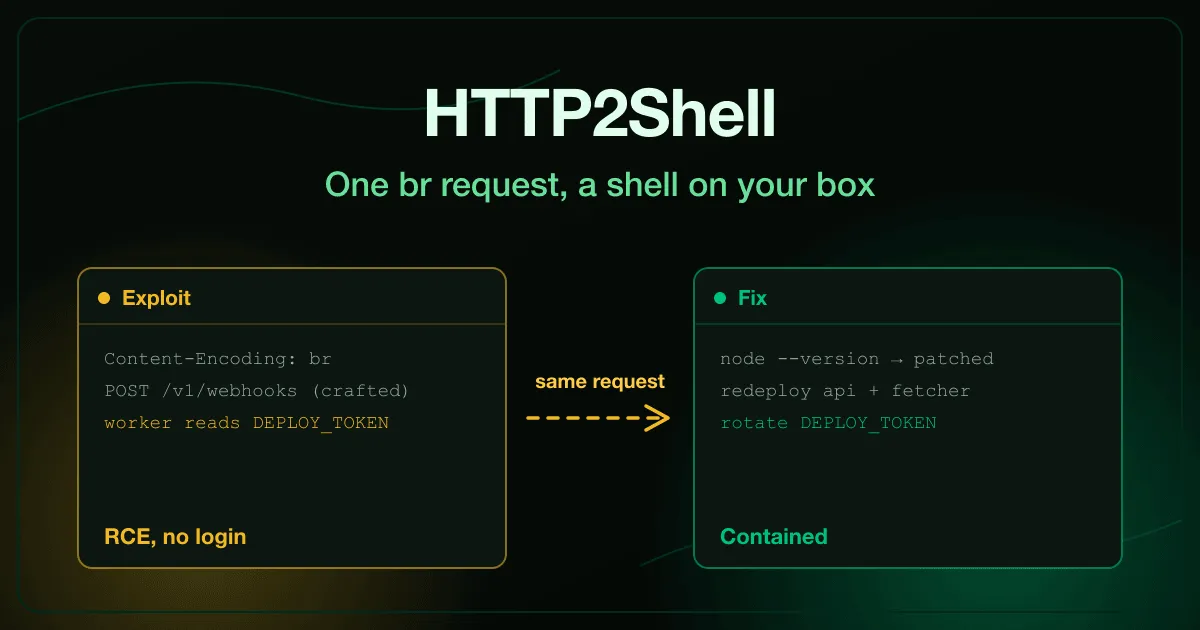
HTTP2Shell remote code execution explained: a crafted Content-Encoding br request leaks a deploy token, then is contained by patching the runtime, redeploying and rotating the token

HTTP2Shell, also called Node2Shell, is the nickname for CVE-2026-111497, an out-of-bounds write in Google’s Brotli decompression library. Fixes shipped on 21 October 2026. Any service that automatically decodes Content-Encoding: br traffic can be pushed into corrupting its own memory, and from there into running attacker commands.

This post walks the attack chain and the response that actually contains it. Everything here mirrors our free HTTP2Shell RCE exercise, where you play both the attacker and the platform engineer on call.
PHP2Shell: How One Request Became RCE, and the Fix

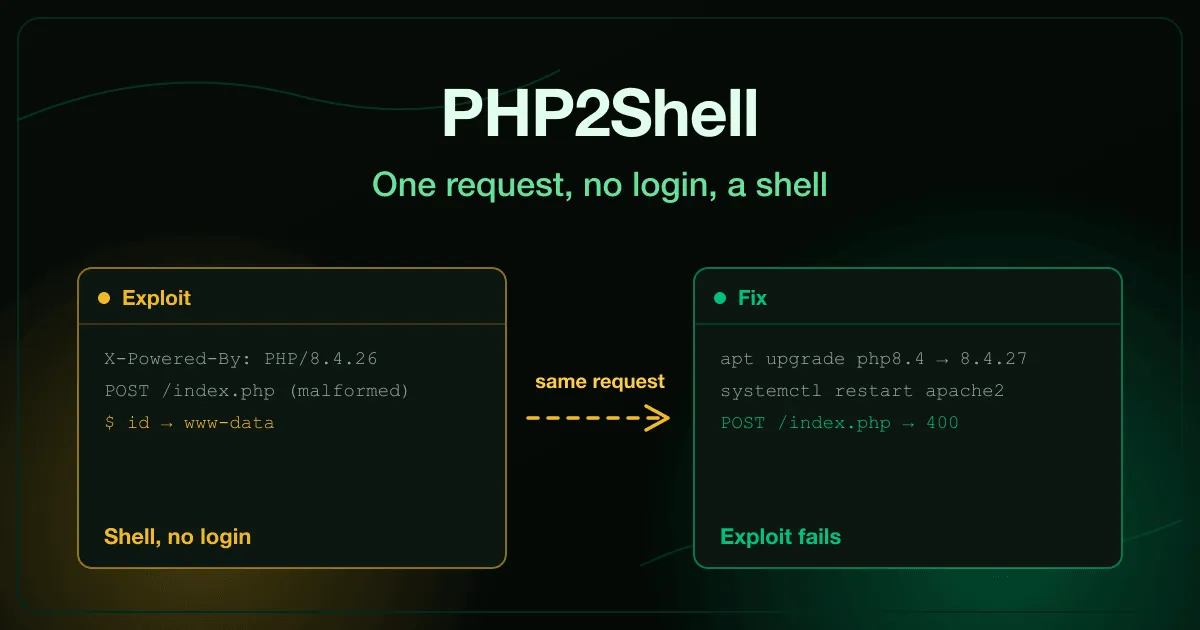
PHP2Shell remote code execution explained: an unauthenticated request runs a shell on PHP 8.4.26, then fails after updating to 8.4.27 and restarting Apache

PHP2Shell is the nickname for two critical PHP runtime flaws, CVE-2026-109618 and CVE-2026-109619, disclosed in October 2026. Together they let an attacker run commands on a web server with one malformed request and no login. Exploitation started on 17 October, four days before PHP shipped fixes on 21 October.

This post walks the attack chain, the response that actually closes it, and the cleanup that patching alone never does. Everything here mirrors our free PHP2Shell RCE exercise, where you play both the attacker and the engineer on call.